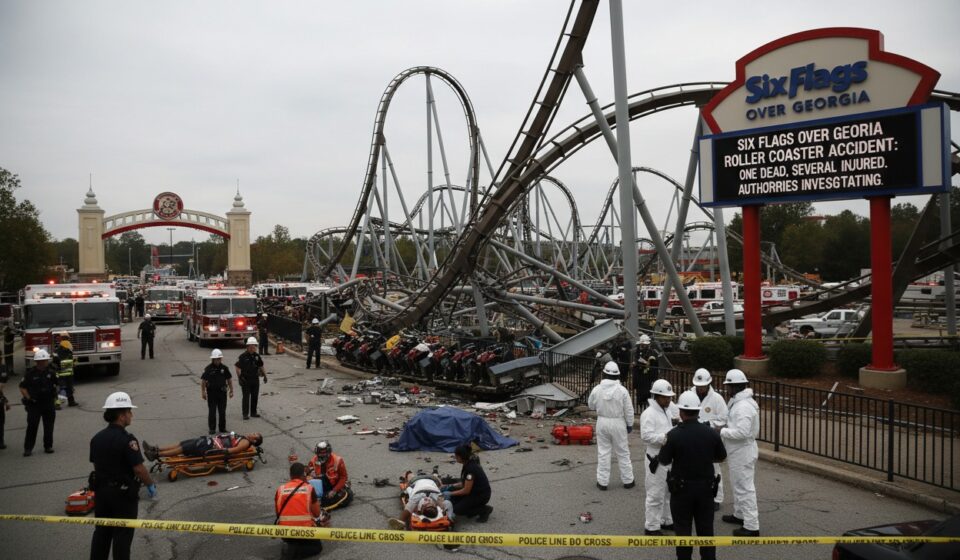
Six Flags Over Georgia Roller Coaster Accident: One Dead and Several Injured as Authorities Investigate

A tragic roller coaster accident at Six Flags Over Georgia has left one man dead and several other people injured, prompting an investigation by local police and state safety officials. The incident occurred on Monday, October 12, 2026, at the amusement park in Austell, near Atlanta, Georgia. Authorities have identified the man who died as 42-year-old Hassan Jihad Ibn Kariem of Atlanta.
The incident has raised serious questions about amusement park safety, passenger restraints, emergency response procedures, and the inspections required to keep high-speed attractions safe. Although investigators have begun examining witness accounts and other available evidence, the exact circumstances that led to the fatal accident have not yet been fully established.
The tragedy has also affected the wider amusement park industry. Six Flags announced the temporary closure of nine similar roller coasters across six theme parks in the United States and Canada as a precaution while the incident is investigated.
What Happened at Six Flags Over Georgia?
The fatal incident took place shortly before 4 p.m. on Monday at Six Flags Over Georgia, a popular amusement park located west of Atlanta. According to the Cobb County Police Department, one person died and several others were reported injured during an incident involving a roller coaster.
Police later identified the deceased individual as Hassan Jihad Ibn Kariem, a 42-year-old Atlanta resident. Preliminary information gathered through interviews with witnesses and employees indicated that Kariem was ejected from the ride, struck other patrons, and then fell beneath the attraction.
Witnesses described a frightening scene in which the man appeared to come out of his seat while the roller coaster was moving. Some witnesses told ABC News that they saw him strike parts of the ride and other passengers before falling to the ground.
The incident was deeply distressing for people who were riding the coaster and those watching from nearby areas. Witness accounts described passengers screaming, crying, and trying to understand what was happening.
Emergency personnel and park staff responded to the incident. Riders on the attraction were subsequently evacuated after the roller coaster stopped near the top of the ride.
Authorities have not yet publicly established the precise sequence of events that led to the accident. In particular, the reason the rider left his seat, the condition of the restraint system, and the factors that contributed to the incident remain subjects for investigation.
Who Was Hassan Jihad Ibn Kariem?
Hassan Jihad Ibn Kariem was a 42-year-old man from Atlanta who worked in education and technology. His death has brought grief to his family, friends, colleagues, and the school community where he had spent more than a decade working with students and staff.
Kariem was employed by Wesley International Academy, where he served in technology-related roles. The school described him as a valued member of its community and expressed sadness over his death.
According to information shared by the school, Kariem had worked there for more than 12 years. His responsibilities included managing information technology, teaching technology, and coaching robotics. His work helped students and colleagues use technology as a practical tool for learning and creativity.
A biography published by the school indicated that he valued the opportunity to make a meaningful difference in the lives of students and staff. Outside his professional responsibilities, he enjoyed working with laser engravers and 3D printers, preparing food, exploring new recipes, watching anime, and spending time with family and friends.
These interests reflected a person who combined technical knowledge with creativity and a commitment to his community.
Following the announcement of his death, the school expressed condolences to those mourning his loss. Its message emphasized his dedication to students, his affection for the school, and the positive influence he had on people around him.
The loss of a teacher, technology professional, or mentor can affect a school community far beyond the immediate workplace. Colleagues may remember the support he provided, while students may remember the skills and encouragement he shared with them.
As the investigation continues, attention remains on the circumstances of the accident as well as the people whose lives have been changed by his death.
The Goliath Roller Coaster: A Major Attraction at the Park
The roller coaster at the center of the incident is identified in reporting as Goliath, one of the major thrill rides at Six Flags Over Georgia.
According to the amusement park’s published information, Goliath reaches approximately 200 feet in height and can travel at speeds of up to 70 miles per hour. The attraction first opened in 2006 and has been a prominent feature of the park for two decades.
Goliath is a steel hypercoaster, a type of roller coaster designed around high speeds, substantial drops, and moments when riders experience a sensation of weightlessness. Unlike rides that focus primarily on inversions, hypercoasters commonly emphasize large hills, steep descents, and sustained momentum.
The scale of these attractions makes them exciting for thrill-seekers, but it also means that their safety systems must function as intended. Passenger restraints, seating arrangements, mechanical components, and operating procedures all contribute to safe operation.
A roller coaster does not rely on a single safety feature. Its overall safety depends on a combination of engineering, maintenance, inspections, staff training, passenger screening, and operating rules.
The fact that Goliath is a high-speed attraction does not, by itself, establish why the fatal incident occurred. Investigators must determine what happened in this particular case rather than assume that the ride’s height or speed was the cause.
That distinction is important because a responsible investigation should be based on technical findings and verified evidence rather than speculation.
Witness Accounts Describe a Terrifying Scene
People who witnessed the incident described a frightening experience that unfolded while the roller coaster was moving.
According to eyewitness accounts reported by ABC News, the man appeared to come out of his seat and strike the ride several times before falling. One witness described seeing the rider turn sideways and move through the air. Another account indicated that people nearby attempted to reach toward him.
Witnesses also described the emotional reaction among passengers. People were reportedly screaming and crying, while concerned visitors called for children and other riders to be released from the attraction.
These accounts provide an initial picture of the event, but they do not independently establish the mechanical cause of the accident.
For example, a witness may observe a rider leaving a seat without being able to determine whether a restraint was improperly secured, whether a component malfunctioned, whether the rider’s position contributed to the event, or whether another factor was involved.
Those questions require a more detailed examination.
Investigators may compare witness statements with physical evidence, employee interviews, maintenance records, inspection documents, and any available photographs or video footage. If relevant data can be recovered from the attraction’s operating systems, it may also help establish the timing and sequence of events.
The purpose of collecting multiple forms of evidence is to create a reliable account of what happened rather than relying on a single observation.
For the witnesses, however, the experience may remain emotionally difficult even after the immediate emergency has ended. Seeing a fatal accident can be deeply distressing, particularly for families and children who expected to spend an ordinary day enjoying an amusement park.
Police and State Officials Investigate the Accident
The Cobb County Police Department is investigating the circumstances surrounding the death. The department said preliminary information from witness and employee interviews indicated that Kariem was ejected from the attraction and struck other patrons before falling beneath the ride.
Investigators continue to examine the incident, and the precise cause has not yet been publicly determined.
Georgia’s Office of the Commissioner of Insurance and Safety Fire is also conducting an investigation. The agency is responsible for amusement ride safety in the state and has said it is undertaking a comprehensive review to determine the circumstances and assess compliance with applicable requirements.
Several important questions may be relevant to the investigation.
First, investigators may examine the ride’s passenger restraint system. They will need to determine how the restraint was functioning, whether it was properly engaged, and whether there is evidence of a mechanical or operational problem.
Second, officials may review the attraction’s maintenance and inspection history. These records can help establish whether required checks were completed and whether any previous problems were reported.
Third, investigators may interview ride operators and other employees to understand the procedures followed before the attraction began operating and during the emergency.
Fourth, officials may review the ride’s design and operating instructions to determine whether the attraction was being operated according to the manufacturer’s specifications and applicable safety rules.
Finally, investigators may consider whether passenger eligibility requirements, restraint checks, and other safety procedures were followed.
These are potential areas of examination, not findings that any specific failure occurred. No conclusion about responsibility should be drawn until investigators have completed their work and released verified information.
A thorough investigation can take time because mechanical evidence, records, and witness statements must be assessed together.
Why Roller Coaster Restraints Matter
Passenger restraints are among the most important safety features on a modern roller coaster. Depending on the design, an attraction may use lap bars, shoulder restraints, seat belts, or a combination of systems.
Their purpose is to keep passengers securely positioned during acceleration, braking, sharp turns, and steep drops.
On a high-speed coaster, riders can experience changing forces as the train moves over hills and through curves. These forces are part of the intended ride experience, but restraints must be designed and maintained to keep passengers within the designated seating area.
The appropriate restraint system varies according to the ride’s design. A system that is suitable for one attraction may not be suitable for another, which is why manufacturers provide specific operating requirements.
Safety also depends on correct use. Operators generally have procedures for confirming that passengers are seated properly and that required restraints are secured before a ride begins.
However, the presence of a restraint system does not automatically prove that a ride is safe in every circumstance, nor does an accident automatically prove that the restraint failed.
Determining whether a restraint malfunctioned requires evidence. Investigators may need to inspect the relevant components, examine their condition, review maintenance records, and establish whether the system was engaged correctly.
Until those findings are available, it would be premature to attribute the Six Flags incident to a particular restraint problem.
The accident nevertheless highlights why restraint inspections, staff training, and adherence to manufacturer instructions are essential parts of amusement ride safety.
Six Flags Temporarily Closes Nine Similar Roller Coasters
One of the most significant consequences of the incident was the decision by Six Flags to temporarily close nine similar roller coasters across six theme parks in North America.
The company said the closures were being carried out out of an abundance of caution. The decision followed the fatal incident at Six Flags Over Georgia and was intended to address safety concerns while the circumstances were examined.
The attractions identified in reporting include:
- Nitro at Six Flags Great Adventure in New Jersey.
- Raging Bull at Six Flags Great America in Illinois.
- Behemoth and Leviathan at Canada’s Wonderland in Ontario, Canada.
- Goliath at Six Flags Magic Mountain in California.
- Fury 325 and Thunder Striker at Carowinds in North Carolina.
- Orion and Diamondback at Kings Island in Ohio.
The temporary closure of these attractions does not mean that each ride has been found to be defective. Rather, the decision reflects a precautionary approach while officials and the company assess the incident and any relevant similarities among the rides.
Many of the affected attractions were designed by Swiss roller coaster manufacturer Bolliger & Mabillard. The company said it was deeply saddened by the accident and was actively investigating the incident.
The manufacturer also indicated that it would not comment further until it had a better understanding of what happened.
The temporary shutdown illustrates how a serious incident at one location can influence operating decisions at other parks. When attractions share design features or other relevant characteristics, operators may decide that reviewing them together is prudent.
The eventual reopening of individual rides will depend on the applicable inspection and review processes, as well as decisions made by the responsible operators and authorities.
Visitors planning trips to affected parks should check official park announcements before traveling, because ride availability may change as inspections and investigations progress.
What Does a Temporary Ride Closure Mean for Public Safety?
Temporary closures can be an important precaution in the amusement industry. When a serious accident occurs, operators may suspend similar attractions while engineers, inspectors, and investigators determine whether additional checks are necessary.
Such decisions can help prevent assumptions about safety from replacing evidence-based reviews.
A temporary closure does not necessarily indicate that a ride has the same problem as the attraction involved in an accident. It can instead provide time for the operator to examine relevant design features, operating procedures, and inspection requirements.
This approach is particularly important when investigators have not yet identified the cause of an incident.
The process may involve checking mechanical components, confirming that restraint systems function correctly, reviewing maintenance documents, and conducting any inspections required by regulators.
Depending on the circumstances, authorities may also require additional testing or documentation before a ride can resume operating.
For amusement park visitors, a closure can be disappointing, especially when a major attraction is a central part of a planned trip. Nevertheless, safety-related closures should be understood in the context of preventing further harm and ensuring that the evidence is properly examined.
Park operators also have a responsibility to communicate clearly with visitors. Accurate information about closures, refunds, alternative attractions, and reopening announcements can help reduce confusion.
At the same time, the public should avoid treating online rumors as confirmed information. Official statements from the park, the relevant regulator, and investigating authorities are more reliable sources for updates.
How Are Amusement Park Rides Inspected?
Amusement ride safety involves multiple layers of oversight. The precise requirements vary by jurisdiction and attraction, but inspection and maintenance programs commonly combine routine operator checks with scheduled technical reviews.
Before a ride opens, staff may conduct operational checks and test runs in accordance with the manufacturer’s instructions and the park’s procedures. These checks help identify visible issues or irregular behavior that require attention before guests are admitted.
Maintenance teams also examine mechanical and electrical systems, moving components, restraint mechanisms, sensors, and other equipment specified by the manufacturer.
More comprehensive inspections may involve trained specialists or government authorities, depending on local law and the type of attraction.
Records are important because they help demonstrate what work was completed, what problems were reported, and how any identified issues were addressed.
If an accident occurs, those records can become a key part of the investigation. Officials may compare documented inspections with physical evidence to determine whether the attraction was maintained and operated in accordance with the relevant requirements.
Nevertheless, no inspection system can be assessed solely by counting the number of checks performed. The quality of inspections, the competence of personnel, the accuracy of documentation, and the response to reported problems all matter.
The Six Flags incident is a reminder that the public depends on these combined systems whenever it boards a high-speed amusement ride.
It is not yet possible to determine from the information publicly available whether an inspection, maintenance, design, operational, or other issue contributed to this particular accident.
The Emotional Impact on Other Riders and Employees
A fatal incident at an amusement park can affect far more people than the individual directly involved.
Passengers who witness a serious accident may experience shock, fear, confusion, and difficulty processing what they saw. Visitors who were nearby can also be affected, even if they were not riding the attraction.
Employees may face an especially challenging situation because they must respond to an emergency while managing the safety and concerns of other guests. Some workers may have witnessed the incident directly, while others may have helped evacuate riders or communicate instructions.
Children and families can be particularly distressed by unexpected emergencies in places associated with entertainment and relaxation.
Support following such an event may include access to professional counseling, assistance from trained staff, and opportunities for affected individuals to speak with trusted people. People experiencing persistent distress may benefit from seeking qualified mental health support.
Six Flags said it was providing support to guests and team members affected by the incident. That response is important because the effects of a traumatic event do not necessarily end when the immediate emergency is over.
For the family of Hassan Jihad Ibn Kariem, the loss is profoundly personal. For his colleagues and students, it also represents the loss of a familiar member of their educational community.
Respect for the family’s privacy is essential while they grieve and while authorities continue their investigation.
The Importance of Responsible Reporting
When a fatal accident attracts widespread attention, information can spread quickly through television, news websites, and social media. Eyewitness accounts may provide useful details, but unverified claims can also create confusion.
Responsible reporting requires a clear distinction between confirmed facts, witness descriptions, and unanswered questions.
In this case, authorities have identified the deceased man, described preliminary findings, and confirmed that an investigation is underway. The park and the state safety agency have also issued statements.
However, the precise cause of the accident has not been established publicly. It would therefore be inappropriate to claim that a particular mechanical component failed or that a specific person or organization was responsible.
Investigators may eventually release further information about the sequence of events and any safety concerns identified during their review.
Until then, readers should be cautious about claims that go beyond the available evidence.
Respectful coverage also means avoiding unnecessary graphic descriptions and recognizing that the people involved are not merely part of a news story. They include a family coping with a death, injured visitors, witnesses, and employees who may have experienced a distressing event.
What Visitors Can Learn From the Incident
Although amusement parks have established safety procedures, visitors can take several practical steps to help reduce avoidable risks.
Before boarding an attraction, guests should read and follow the posted safety instructions. Height, age, health, and seating restrictions are intended to help determine whether a person can safely use a particular ride.
Passengers should sit in the designated position and use restraints exactly as instructed by park employees. They should never attempt to modify, bypass, or interfere with safety equipment.
If a restraint does not appear to fit correctly or a passenger feels uncertain about whether it has been secured, the concern should be raised with a ride operator before the attraction begins moving.
Visitors should also follow instructions during an emergency. Attempting to leave a stopped ride without authorization can create additional risks, especially when a train is elevated above the ground.
Families visiting theme parks can prepare children by explaining that ride restrictions and operator instructions must be followed. Children should understand that safety directions remain important even when an attraction looks familiar or exciting.
These precautions do not shift responsibility for a ride’s safe design, maintenance, and operation onto visitors. Those responsibilities remain with the relevant operators, manufacturers, and oversight authorities according to their respective duties.
The purpose of passenger awareness is to complement established safety systems, not replace them.
What Happens Next in the Investigation?
The next stage of the investigation will involve examining the available evidence and determining whether further technical testing or regulatory action is required.
Police investigators may continue interviewing witnesses and employees. State safety officials may examine the ride, review relevant records, and assess compliance with applicable requirements.
The manufacturer may also contribute technical expertise as the investigation proceeds.
A complete assessment may require time because investigators must establish not only what happened but also why it happened. The distinction is important: describing a rider’s fall is not the same as identifying the underlying factors that allowed the event to occur.
Authorities may also consider whether findings from the Georgia incident have implications for other attractions that share relevant design or operating characteristics.
Meanwhile, Six Flags will need to follow applicable safety and inspection procedures before affected rides return to service. The reopening schedule may vary by attraction and jurisdiction.
As of the latest reporting on October 13, 2026, the investigation remained ongoing, and the precise cause had not been publicly established.
Readers should look to updates from the Cobb County Police Department, Georgia’s Office of the Commissioner of Insurance and Safety Fire, and Six Flags for verified developments.
The fatal roller coaster incident at Six Flags Over Georgia has resulted in the death of 42-year-old Hassan Jihad Ibn Kariem and injuries to several other people. The tragedy has prompted investigations by police and state safety officials, as well as precautionary closures of nine similar roller coasters at six theme parks across North America.
Kariem’s work at Wesley International Academy and his contributions to students and colleagues have become an important part of the story surrounding his death. His loss has affected a community that valued his dedication to technology, education, and creative learning.
At the same time, the incident has placed renewed attention on the safety systems that support modern amusement rides. Restraints, maintenance, inspections, employee training, and effective emergency procedures all play important roles in protecting passengers.
The temporary closure of similar attractions demonstrates the industry’s response while important questions remain unanswered. However, the closures should not be mistaken for proof that every affected ride is unsafe or that a particular component caused the accident.
Ultimately, the investigation must establish the facts and identify any necessary corrective measures. Until officials release their findings, the cause of the incident remains unresolved.
For visitors, the tragedy is a reminder to follow safety instructions and respect ride restrictions. For park operators and regulators, it underscores the importance of careful oversight, transparent communication, and a continued commitment to passenger safety.
Above all, the incident represents a devastating loss for a family and a school community. As the investigation continues, the priority remains understanding what happened, supporting those affected, and using verified findings to help prevent similar tragedies in the future.
Frequently Asked Questions (FAQs)
1. What happened at Six Flags Over Georgia?
One man died and several other people were injured in a roller coaster incident at the park on October 12, 2026. Police are investigating the circumstances.
2. Who died in the roller coaster accident?
Authorities identified the deceased man as Hassan Jihad Ibn Kariem, a 42-year-old resident of Atlanta, Georgia.
3. Which roller coaster was involved?
The incident has been associated with Goliath, a major steel hypercoaster at Six Flags Over Georgia that reaches approximately 200 feet and speeds of up to 70 mph.
4. Why were other roller coasters temporarily closed?
Six Flags temporarily closed nine similar attractions across six North American parks as a precaution following the fatal incident. The closures do not establish that each ride has a defect.
5. Has the cause of the accident been confirmed?
No. As of October 13, 2026, police and state safety officials were still investigating. The exact cause had not been publicly established.
Sources and further reading
Visit OUR Website:
Website:
Visit SOCIAL Media
YouTube:
Facebook:
Pinterest:
#everyone #viralfb #viralfbpost #viral #viralpost #foryoü #trending #trendings #trendingnow #foryouシ