Xiaomi Redmi 17 Arrives in Bangladesh: A Battery-First Bet in a Crowded Mid-Range Market
Introduction
Xiaomi Bangladesh has pulled back the curtain on the Redmi 17, the newest addition to a lineup that has quietly become the backbone of the company’s local business. Rather than chasing the megapixel wars or folding-screen gimmicks that dominate flagship marketing cycles, Xiaomi has chosen to make a very specific, very deliberate bet with this device: battery life above almost everything else. In a country where load-shedding, long commutes, and all-day usage patterns make charger access unpredictable, that bet is not a marketing gimmick — it’s a direct response to how people in Bangladesh actually use their phones.
The Redmi 17 lands as the mainstream sibling in a broader family that already includes the more premium Xiaomi 17T and the Redmi Pad 2 tablet, both introduced in the local market earlier this year. It also arrives just days after Xiaomi unveiled the Redmi Note 17 5G in the neighbouring Indian market, a device that leans on a similar “big battery, big screen” formula. Together, these launches paint a picture of a company doubling down on endurance as its core value proposition across South Asia, rather than treating it as a single-market experiment.
The Headline Feature: A 7,500mAh Battery
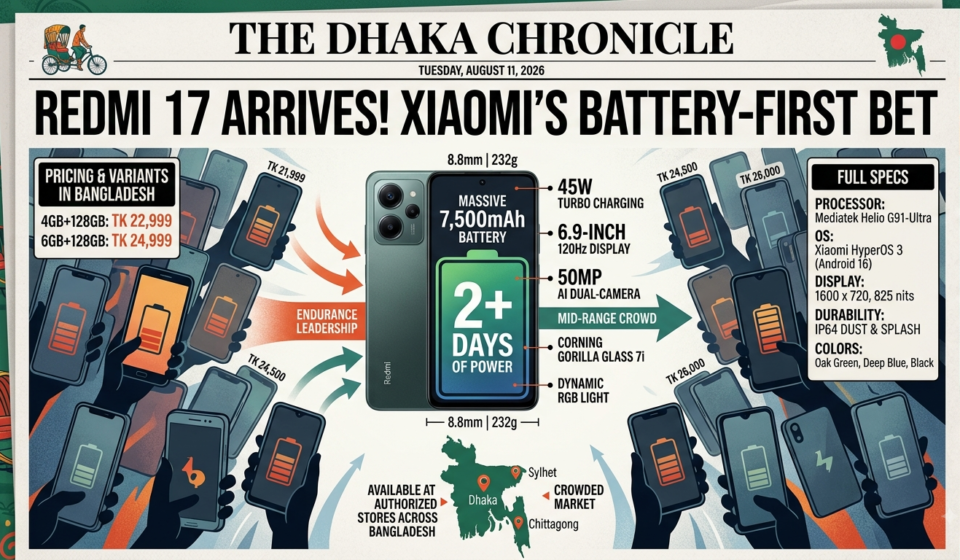
The single number Xiaomi wants every buyer to remember is 7,500. That’s the capacity, in milliamp-hours, of the battery packed into the Redmi 17 — a figure that comfortably outsizes what most competitors offer in the same price bracket, where 5,000mAh to 6,000mAh cells remain the norm. Xiaomi’s own claims put typical battery life at over two days on a single charge, covering everything from video streaming and online classes to gaming and constant messaging.
For context, this isn’t just an incremental bump. It represents roughly 25 to 50 percent more raw capacity than what many users are accustomed to, translated directly into fewer charging cycles per week. For students attending online classes, gig workers who rely on their phone for navigation and communication throughout the day, or small business owners managing everything from a single device, that difference can be the gap between constant charger-anxiety and simply not thinking about battery percentage at all.
Complementing the larger cell is 45W Turbo Charging, which Xiaomi says can take the phone from empty to roughly half charge in about 45 minutes. That pairing matters: a bigger battery without proportionally faster charging support would mean longer waits whenever a top-up is actually needed. By combining size with speed, Xiaomi is trying to make sure the Redmi 17 doesn’t just last longer between charges, but also doesn’t become an inconvenience during the rare moments it does need to be plugged in.
Display and Design
The Redmi 17 features a 6.9-inch display running at a 120Hz refresh rate, putting it firmly in today’s “phablet” territory. The larger canvas is well suited to the kind of media-heavy, multitasking-oriented use case Xiaomi is targeting — video content, social feeds, mobile gaming, and split-screen productivity all benefit from the additional real estate, while the 120Hz panel keeps scrolling and animations feeling fluid rather than sluggish.
Protecting that display is Corning Gorilla Glass 7i, a mid-tier protective glass that offers meaningfully better drop and scratch resistance than the glass typically found on budget devices, without pushing the cost up to flagship-tier Gorilla Glass Victus levels. It’s a sensible compromise for a device positioned as a durable daily driver rather than a premium showpiece.
Visually, the phone leans into a design flourish Xiaomi calls Dynamic RGB Light — a lighting element intended to give the device a more distinctive, premium-feeling presence compared to the fairly uniform look of most phones in its price class. Whether that resonates as a genuine design differentiator or simply a marketing flourish will likely come down to hands-on impressions, but it does signal that Xiaomi wants the Redmi 17 to stand out on a retail shelf, not just in a spec sheet.
Performance and Software
Powering the device is the MediaTek Helio G91-Ultra, a chipset built for everyday reliability rather than benchmark-chasing performance. It’s paired with Xiaomi’s HyperOS 3 software layer, which the company says is designed to deliver up to four years of smooth, consistent performance — an important promise in a market where many buyers hold onto a phone for several years before upgrading, and where software slowdown over time is a common complaint.
This combination suggests Xiaomi is optimizing the Redmi 17 for longevity in two distinct senses: hardware durability through the reinforced glass and dust/splash resistance, and software durability through sustained update and performance support. For budget-conscious buyers who can’t refresh their device every 18 months, that’s arguably a more meaningful promise than raw processing power.
Camera System
On the imaging side, the Redmi 17 is equipped with a 50MP AI dual-camera system. Xiaomi frames this less as a specs flex and more as a tool for everyday moments — family gatherings, casual outings, quick social posts — rather than professional-grade photography. That framing lines up with where the device sits in the broader Xiaomi ecosystem: photography enthusiasts in Bangladesh looking for Leica-tuned optics and long telephoto reach are steered toward devices like the Xiaomi 17T, which packs a Leica Summilux-branded main sensor and a 50MP telephoto lens with up to 120x AI zoom. The Redmi 17, by contrast, is built for reliable, competent shots without asking the user to think too hard about settings.
Durability: IP64 Dust and Splash Resistance
Rounding out the phone’s practical credentials is an IP64 rating, which protects against dust ingress and splashing water from any direction — enough to handle rain, spills, or a sudden downpour during Dhaka’s monsoon season, though not full submersion. Combined with the reinforced Gorilla Glass 7i front, Xiaomi is positioning the Redmi 17 as a phone built to survive the realities of daily use in Bangladesh’s climate and infrastructure, rather than one that needs to be babied inside a case at all times.
Pricing and Availability
Xiaomi Bangladesh has priced the Redmi 17 starting from ৳22,999 for the base 4GB+128GB configuration, with a 6GB+128GB variant also available at launch. That pricing places the device squarely in the competitive mid-range segment, where Bangladeshi consumers weigh options from Samsung’s Galaxy A-series, Realme’s Note and C-series lines, Infinix, and Xiaomi’s own Redmi Note family — all fighting over the same budget-conscious, feature-hungry customer.
The Redmi 17 is now available through all Xiaomi-authorized stores and retail partners across the country, meaning the company is leaning on its already dense local retail network rather than staggering availability through online-only or flash-sale models, a strategy some rivals still use to manufacture hype.
What Xiaomi’s Country Manager Had to Say
Speaking at the launch, Ziauddin Chowdhury, Country General Manager of Xiaomi Bangladesh, framed the device as an answer to the practical demands of contemporary phone use. His comments centered on the idea that the Redmi 17 was built to deliver a dependable, powerful smartphone experience by combining long battery life, reinforced Gorilla Glass protection, fast charging, and durable everyday performance into a single cohesive package — rather than treating any one of those attributes as an isolated selling point.
That framing is worth taking seriously. Xiaomi has built its Bangladesh market position — where it holds the top spot among handset brands — on exactly this kind of value-stacking, and the messaging around the Redmi 17 doubles down on that formula rather than reinventing it.
Regional Context: A Pattern, Not a One-Off
The Redmi 17’s arrival in Bangladesh doesn’t exist in isolation. Just a few days prior, Xiaomi launched the Redmi Note 17 5G in India, a device that similarly foregrounds battery capacity — in that case, an even larger 8,000mAh cell — over camera specs or premium materials. It ships with a Snapdragon 4 Gen 4 chipset, a 6.99-inch AMOLED display, and 45W wired charging, and is being sold with EMI financing options through partners like Bajaj Finance to make the up-front cost more manageable for buyers.
Seen together, these near-simultaneous launches suggest Xiaomi’s regional product strategy for South Asia in the second half of 2026 is converging on a clear thesis: for budget and mid-range buyers, uninterrupted battery life beats marginal camera or design upgrades. Whether that thesis holds depends heavily on execution — battery claims under real-world, mixed usage often fall short of lab-tested projections, and Xiaomi’s “over two days” promise will inevitably be tested against actual behavior: brightness levels, network conditions, background app activity, and gaming intensity all chip away at theoretical battery life.
The Competitive Calculus
For Bangladeshi consumers, the Redmi 17’s true test won’t be its spec sheet but how it holds up against a genuinely crowded field. Samsung continues to dominate brand trust in the region even at higher price points, Realme and Infinix compete aggressively on price-to-spec ratio, and Xiaomi’s own Redmi Note series occupies adjacent price tiers that could cannibalize interest in the Redmi 17 rather than complement it.
What likely sets the Redmi 17 apart isn’t any single spec in isolation — 7,500mAh batteries, 120Hz displays, and 50MP cameras are increasingly common across this price segment — but Xiaomi’s willingness to stack all of them into a starting price under ৳23,000, backed by an already-extensive retail and service network across Bangladesh. That combination of price, distribution, and battery-first messaging gives Xiaomi a coherent story to tell retail customers walking into a store undecided between three or four similarly specced phones.
Looking Ahead
The Redmi 17 is unlikely to make headlines for breaking new technological ground — nothing about MediaTek’s Helio G91-Ultra, a 50MP dual camera, or an IP64 rating pushes the boundaries of what mid-range smartphones currently offer. Its significance lies elsewhere: in what it signals about how Xiaomi reads the Bangladeshi market and, by extension, similar markets across South Asia. Battery anxiety, not camera envy, appears to be the pain point Xiaomi believes it can most profitably solve for the next wave of upgraders.
Whether rivals respond with their own battery-first mid-rangers, or whether Xiaomi’s calculated bet on endurance over showmanship pays off at scale, will likely shape how the region’s smartphone marketing evolves over the coming year. For now, the Redmi 17 gives Bangladeshi buyers a straightforward pitch: a phone that, in Xiaomi’s words, delivers power when they need it most — and, just as importantly, for as long as they need it.
FAQs: Xiaomi Redmi 17 (Bangladesh)
1. What is the price of the Redmi 17 in Bangladesh? It starts at ৳22,999 for the 4GB+128GB variant, with a 6GB+128GB option also available.
2. How long does the battery last on a single charge? Xiaomi claims over two days of typical use, thanks to the 7,500mAh battery.
3. Does it support fast charging? Yes, it supports 45W Turbo Charging, reaching about 50% in roughly 45 minutes.
4. What processor and software does it run? It uses the MediaTek Helio G91-Ultra chipset paired with Xiaomi HyperOS 3.
5. Is the phone durable against water and dust? It has an IP64 rating for dust and splash resistance, plus a Corning Gorilla Glass 7i display.
Sources: Dhaka Tribune, The Daily Star, New Age Bangladesh, Xiaomi Bangladesh official channels, MobileDokan, and The Tribune (India), reporting between late July and August 2026.