
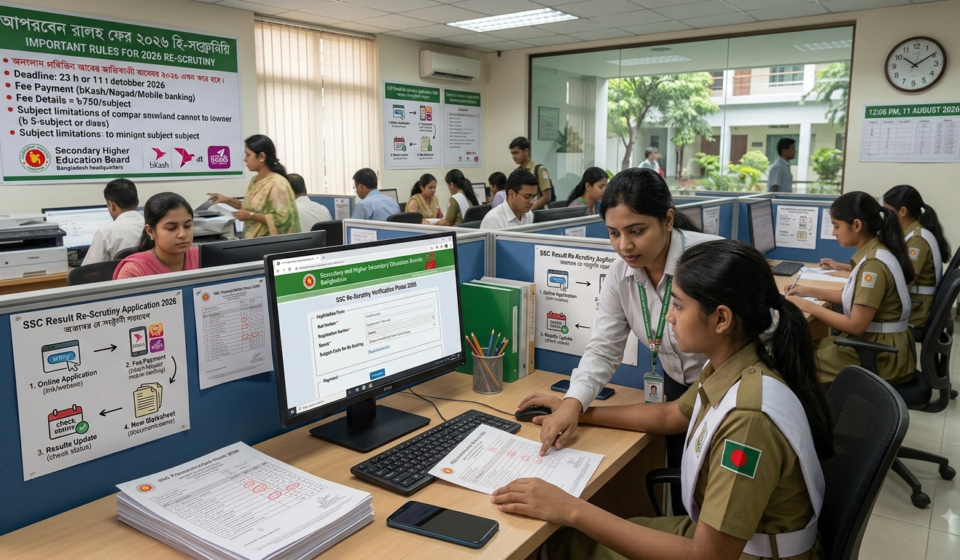
SSC Result Re-Scrutiny 2026: A Complete Guide to the New Online Process, Rules, Deadlines, Fees, and What Students Must Know
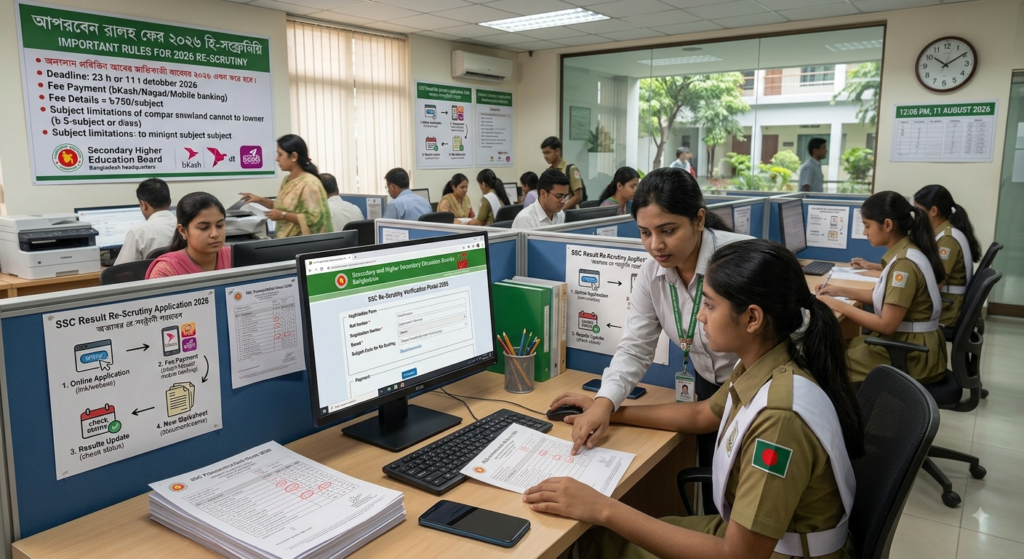
SSC Result Re-Scrutiny 2026: A Complete Guide to the New Online Process, Rules, Deadlines, Fees, and What Students Must Know
The Secondary School Certificate (SSC) and equivalent examination results for 2026 were published on Monday, bringing a mix of celebration, relief, and disappointment for hundreds of thousands of students across Bangladesh. As is customary every year, the education boards have opened a window for students who are dissatisfied with their marks to apply for re-scrutiny (also commonly called challenge of examination scripts or rechecking). This year, however, the entire process has undergone significant changes. Applications are now fully online through a dedicated portal, manual submissions are no longer accepted, and the timeline, payment methods, and procedural steps have been updated.
According to a notice issued by the Dhaka Education Board (and followed by other boards), students can apply for re-scrutiny from 11 August to 17 August 2026. That gives candidates exactly one week to decide, gather the necessary details, and complete the online process. Missing this short window means forgoing the opportunity entirely.
Why Re-Scrutiny Matters and Who Should Consider It
Re-scrutiny is not a full re-evaluation of answers in the traditional sense of rewriting or re-marking every detail from scratch. In the Bangladeshi board system, it primarily involves checking whether all answers were properly assessed, marks were correctly added, and any unmarked portions were overlooked. It can result in an increase, decrease, or no change in marks. Students who received unexpectedly low grades in specific subjects, or those whose overall GPA is close to a higher grade boundary, often find it worthwhile. Borderline cases—such as students missing an A+ by a few marks or failing one paper while performing well elsewhere—are among the most common applicants.
This year, nearly 700,000 candidates failed the SSC and equivalent exams, and hundreds of institutions recorded a zero pass rate. With large numbers of students falling short of their expectations, demand for re-scrutiny is expected to be high. At the same time, authorities have streamlined the process to handle volume efficiently and reduce opportunities for irregularities associated with paper-based applications.
The New Online Application Portal and Step-by-Step Process
The designated portal is https://rescrutiny.eduboardresults.gov.bd. Students (or guardians acting on their behalf) must follow these steps carefully:
- Visit the portal and enter the student’s roll number and registration number in the respective fields.
- Select the correct education board from the drop-down menu.
- Click the “Submit” button.
- Provide a valid mobile phone number. An SMS with the re-scrutiny outcome will later be sent to this number, so accuracy is essential.
- On the next screen, the subject-wise published results will appear. Select the subject(s) or paper(s) for which re-scrutiny is desired.
- Click the “Pay Fee” button.
- A fee of Tk 150 will be charged for each paper. Important note: For subjects that consist of two papers (common in many SSC subjects), applications must be submitted for both papers if the student wants both checked. The system will calculate and display the total amount payable.
- Payment can be made through bKash, Nagad, or Sonali Seba. Detailed payment instructions are available by clicking the “Help” button on the portal.
- After successful payment, return to the application portal and click the final “Submit” button to complete the process.
Once the fee has been paid for specific subjects, those subjects cannot be withdrawn, and the fee is non-refundable under any circumstances. However, before payment, applicants can use the “Delete” option to remove selected subjects and choose different ones. After the initial application is submitted with payment, students may still add further subjects later by following the same procedure; they will not need to re-enter the mobile number.
No manual or offline applications will be accepted at board offices or schools. This digital-only approach aims to increase transparency, reduce queues, and create a clear digital trail of every application and payment.
Key Rules, Limitations, and Practical Tips
- Deadline: Applications open on 11 August and close on 17 August 2026. Do not wait until the last day; technical glitches, payment failures, or high traffic can cause delays.
- Fee structure: Tk 150 per paper. Budget accordingly if applying for multiple subjects or dual-paper subjects.
- Payment methods: bKash, Nagad, and Sonali Seba are supported. Ensure the mobile wallet has sufficient balance and that the transaction PIN is ready. Keep screenshots or transaction IDs as proof.
- Mobile number: The number provided will receive the eventual re-scrutiny result via SMS. Use a number that will remain active and accessible.
- No refunds or withdrawals after payment: Double-check subject selection before paying.
- Adding subjects later: Possible after the first successful submission, which offers some flexibility.
- Result of re-scrutiny: Will be communicated via SMS to the registered mobile number. Boards typically publish revised marksheets or updated results after completing the process for all applicants; the exact timeline after 17 August is not detailed in the initial notice but historically takes several weeks.
Students should cross-verify their roll and registration numbers from their original admit cards or result sheets before starting. Any mismatch will prevent access to the correct record. It is also advisable to use a stable internet connection and a modern browser to avoid form submission errors.
Broader Context of the 2026 SSC Results
The publication of results on Monday revealed significant challenges in the education system. Nearly 700,000 candidates failed, and 312 institutions recorded a zero pass rate. Simultaneously, reports indicated that approximately 1.36 million seats in Class 11 (higher secondary) would remain vacant, reflecting a mismatch between the number of successful SSC candidates and available capacity at the next level. These figures underscore both the competitive pressure on students and systemic issues related to teaching quality, examination standards, and institutional performance in certain areas.
In this environment, re-scrutiny serves as an important safety valve. It allows individual students a chance to correct possible administrative or assessment errors without requiring a full re-examination. For families who have invested years of effort and resources into a student’s education, the relatively modest fee of Tk 150 per paper is often seen as a reasonable investment for peace of mind or a potential grade improvement that could affect college admission prospects.
Advice for Students and Guardians
Decide early which subjects truly warrant re-scrutiny. Focus on papers where the obtained marks seem inconsistent with the student’s preparation or performance in other subjects, or where a small increase could change the letter grade or GPA. Avoid applying for every subject simply out of disappointment; the process is best used selectively.
Prepare all information in advance: roll number, registration number, board name, list of desired subjects/papers, and a working mobile number with digital payment capability. If a student does not have personal access to bKash, Nagad, or Sonali Seba, a trusted guardian or relative can assist with payment.
After submitting, monitor the registered mobile number for the SMS notification. Keep records of the application (screenshots of confirmation pages and payment receipts). In case of any technical difficulty with the portal, the “Help” section should be consulted first; persistent issues may require contacting the relevant education board through official channels, though boards generally emphasize self-service via the online system.
Looking Ahead
The shift to a fully digital re-scrutiny process marks another step in the digitization of Bangladesh’s education administration. If implemented smoothly, it should reduce delays, minimize human error in application handling, and provide faster feedback to students. At the same time, it places greater responsibility on applicants to navigate online systems correctly and complete payments on time.
For the Class of 2026, the next few weeks will determine whether their published results stand or receive upward (or, in rare cases, downward) adjustments. Students who perform well after re-scrutiny may improve their options for higher secondary admission, while those whose marks remain unchanged will need to plan alternative pathways, including possible re-sitting of exams in future sessions where applicable.
The education boards have made the rules clear: one week, fully online, Tk 150 per paper, non-refundable after payment, and no manual applications. Students and families who act promptly, follow the portal instructions carefully, and select subjects judiciously will maximize their chances of a smooth experience. The portal address again for reference is https://rescrutiny.eduboardresults.gov.bd. Applications run from 11 to 17 August 2026.
This streamlined yet strict process reflects the boards’ dual goals of offering recourse to students while managing the logistical scale of post-result activities efficiently. Whether the outcome of re-scrutiny changes a grade or simply confirms the original result, participating thoughtfully remains an important option for many in the days ahead. Students are encouraged to review their marksheets carefully, consult teachers or guardians if needed, and complete the online application well before the 17 August deadline to avoid last-minute complications.
In summary, the 2026 SSC re-scrutiny window is short, digital-only, and governed by clear fee and procedural rules. Understanding every step—from entering credentials and selecting papers to paying via mobile financial services and receiving the final SMS—will help students navigate the system successfully. With nearly 700,000 failures and thousands of institutions under pressure, individual attention to one’s own results through this process can still make a meaningful difference for determined candidates. Act within the given dates, follow the official portal instructions precisely, and keep all transaction records safe. The opportunity exists; using it correctly is now in the hands of each student and family.
Here are 5 related FAQs based on the SSC and equivalent exam re-scrutiny process announced by the education boards:
1. When can I apply for SSC result re-scrutiny and what is the deadline?
Applications open on 11 August and close on 17 August. Students have exactly one week to submit their online applications. No extensions are mentioned, so it is advisable to apply early to avoid last-minute technical issues.
2. How do I apply for re-scrutiny and is the process fully online?
Yes, the process is completely online. Visit the official portal https://rescrutiny.eduboardresults.gov.bd, enter your roll number and registration number, select your education board, provide a mobile number, choose the subjects/papers you want re-scrutinised, pay the fee, and submit. No manual or offline applications are accepted.
3. How much does re-scrutiny cost and how do I pay?
The fee is Tk 150 for each paper. For subjects that have two papers, you must apply (and pay) for both if you want both checked. Payment can be made through bKash, Nagad, or Sonali Seba. Detailed payment instructions are available via the “Help” button on the portal. Fees are non-refundable once paid.
4. Can I change or add subjects after starting the application?
Before paying the fee, you can delete selected subjects and choose different ones. After successful payment and submission, you cannot withdraw any subjects or get a refund. However, you can still add more subjects later by following the same process (you will not need to re-enter your mobile number).
5. How will I receive the re-scrutiny result?
You must provide a valid mobile phone number during the application. The re-scrutiny result will be sent to that number via SMS once the process is completed by the boards. Make sure the number remains active and accessible.