

Breast Cancer in 2026: What the Latest Numbers Say About Diagnosis, Survival, and Who Is Still at Greater Risk
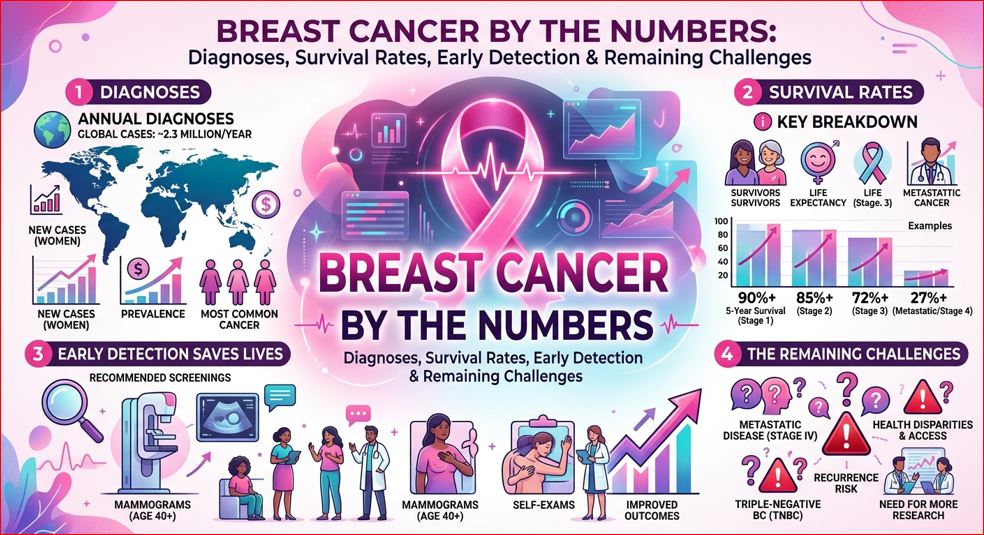
Every October, Breast Cancer Awareness Month brings pink ribbons, fundraising walks, and a flood of statistics. The numbers can feel abstract until you understand what they mean for real people. The figures reported around the start of this year’s awareness month tell a mixed story. More women are being diagnosed, but far fewer are dying from the disease, and the odds of living long after a diagnosis are better than they have ever been. Gaps in who benefits from that progress also remain.
This article walks through the key data, explains the terms behind them, and describes what the figures suggest about screening and early detection.
The Big Picture: A Common Cancer With Improving Odds
Breast cancer is the most frequently diagnosed cancer among women in the United States, apart from skin cancers. The American Cancer Society (ACS) expects more than 320,000 new invasive cases each year. Invasive means the cancer has grown beyond the ducts or lobules where it started and into surrounding breast tissue.
The disease accounts for roughly one in every three new cancers found in women annually. It is also the second leading cause of cancer death among American women, behind lung cancer.
Diagnoses have crept upward, by about 1% per year in recent years according to the ACS. The reasons are complex and not fully settled. Longer life expectancy, changing reproductive patterns, lifestyle factors, and better detection all likely play a part. Wider screening finds cancers that might once have gone unnoticed for years.
A rising diagnosis rate is not the same as a rising death rate, and here the news is encouraging. As Hannah Rose Naughton, a breast surgical oncologist at Hackensack Meridian Health, put it to ABC News, most women diagnosed with breast cancer do very well, and outcomes have improved dramatically over time.
A Remarkable Drop in Deaths
Between 1989 and 2024, the breast cancer death rate among U.S. women fell by 44%. The ACS estimates that this decline prevented between 500,000 and roughly 518,000 deaths over that period. That is hundreds of thousands of mothers, sisters, daughters, and friends who lived on.
Experts credit two broad developments working together:
- Better screening. Mammography and related imaging catch cancers sooner, often before a lump can be felt, when treatment is more likely to work.
- Better treatment. Breast cancer is not one disease. It has several subtypes, and therapies are now matched to a tumor’s biology. Hormone-blocking drugs, targeted agents, and improved surgical and radiation techniques have all contributed.
Priya Thomas, a breast oncologist at the University of Texas MD Anderson Cancer Center, also points to artificial intelligence as an emerging factor. Researchers are investigating whether AI tools can sharpen the sensitivity of imaging, helping radiologists spot subtle abnormalities. That work is still being studied, but it reflects how much of the field’s progress comes from technology.
Understanding Survival Rates
Survival statistics are among the most quoted and most misunderstood numbers in cancer care. The figure most often cited is the five-year relative survival rate. It compares the share of people with a given cancer who are alive five years after diagnosis to the share of people of the same age in the general population who are alive over the same period. A relative rate adjusts for the fact that some people die of unrelated causes.
In the late 1970s, the five-year relative survival rate for women with invasive breast cancer was roughly 75%. According to the National Cancer Institute (NCI), as of 2022 it is above 90%. In practical terms, a woman diagnosed today has a much better chance of being alive five years later than a woman diagnosed two generations ago.
Three cautions are worth keeping in mind:
- Survival rates are averages. They describe large groups, not any one person. Individual outcomes depend on the tumor’s subtype, size, and grade, the patient’s age and overall health, and how well the cancer responds to treatment.
- They reflect past treatment. A five-year figure is based on people diagnosed years ago. Today’s therapies may do even better.
- Five years is a milestone, not a finish line. Some breast cancers, particularly certain hormone-driven types, can recur many years later, which is why long-term follow-up matters.
Why Stage at Diagnosis Matters So Much
Among the strongest predictors of outcome is the stage at which the cancer is found. Staging describes how far the disease has progressed, and NCI data show where most breast cancers land:
| Stage at diagnosis | Share of cases |
| Localized (confined to the breast) | About 64% |
| Regional (spread to nearby lymph nodes or tissue) | About 27% |
| Distant (spread to other parts of the body) | About 6% |
| Unknown | About 2% |
The takeaway is hopeful: nearly two-thirds of breast cancers are found while still confined to the breast, and the overwhelming majority are found before they spread to distant organs. That distribution is a direct payoff of screening and public awareness.
It also explains the message oncologists repeat so often: the earlier a cancer is found, the better the outcome tends to be. A tumor caught while small and local can frequently be treated with less aggressive surgery and a higher chance of cure than one that has already traveled.
Not Just a Women’s Disease
Breast cancer is overwhelmingly a disease of women, but men have breast tissue too and can develop the disease. About 1% of all breast cancer cases occur in men, which makes it extremely rare, according to Thomas. Because it is so uncommon, men may not think to report a breast lump, and diagnosis can be delayed.
The ACS reports that men are typically diagnosed between ages 60 and 70. Any man who notices a lump, nipple changes, or skin changes in the chest area should have it checked just as promptly as a woman would.
Age and the Timing of Risk
As with most cancers, risk rises with age. The average age at diagnosis for women is 63, according to the NCI. That does not mean younger people are safe. Breast cancer can occur at nearly any age in both women and men, and diagnosis at a younger age has been linked to higher mortality. Younger patients can face more aggressive tumor types, and because routine screening usually begins later, their cancers can be harder to catch early.
This is one reason experts stress awareness of your own body at every age, not just the screening years.
Disparities That Persist
The decline in deaths has not been shared equally. Race and ethnicity remain linked to different outcomes.
Naughton notes that Black women are more likely to develop triple-negative breast cancer, a subtype that can be more aggressive and has fewer targeted treatment options. Black women also have a higher breast cancer mortality rate than other groups. The causes are layered. They include differences in tumor biology, but also unequal access to timely screening, high-quality follow-up care, and treatment, as well as broader social and economic barriers.
Closing these gaps is widely seen as one of the biggest remaining challenges. Improving the average survival rate matters, but progress is incomplete if some communities are left behind. Efforts to expand access to mammography, support patients through diagnosis and treatment, and include diverse populations in clinical research all aim at this problem.
Screening: What the Experts Recommend
Screening guidelines have been a topic of debate, and different organizations have offered slightly different advice, including suggestions that some women may screen every one to two years. Naughton acknowledges those variations but says she still recommends yearly mammograms beginning at age 40 for women at average risk.
Guidelines are a starting point, not a one-size-fits-all rule. Women with a strong family history, known inherited mutations such as BRCA1 or BRCA2, prior chest radiation, or other elevated-risk factors may need earlier or additional screening, such as breast MRI. The best step is to discuss personal risk with a health care provider and agree on a plan.
Know Your Baseline: Symptoms Worth Reporting
Mammograms are powerful, but they are not the only line of defense. Thomas advises anyone who feels a lump, notices a skin change, sees nipple discharge, or detects any change from their normal baseline to get it evaluated by a provider. Naughton’s message is similar: do not ignore a change in your breast.
Changes worth reporting include:
- A new lump or thickened area in the breast or underarm
- Changes in breast size or shape
- Dimpling, puckering, redness, or scaling of the skin
- Nipple turning inward, or unusual discharge
- Persistent breast or nipple pain that is new for you
Most breast changes turn out not to be cancer. Still, only an evaluation can tell, and waiting rarely helps.
What the Numbers Mean Going Forward
Taken together, the statistics describe a field that has made real, measurable progress. Diagnoses are slightly rising, death rates have fallen sharply, survival has climbed from about 75% to above 90%, and most cancers are found before they spread. Each trend traces back to the same pillars: awareness, screening, and improving treatment.
Yet the figures also show where work remains. Disparities in outcomes, delays in diagnosis among younger patients, and the rarity-driven blind spots for men all call for continued attention. Awareness month is a reminder that statistics only become life-saving when they lead to action, whether that is scheduling a mammogram, learning your family history, or getting a new symptom checked.
Frequently Asked Questions
1. How common is breast cancer in the United States?
It is the most commonly diagnosed cancer in women apart from skin cancer, with more than 320,000 new invasive cases expected each year. It makes up about one in three new cancers diagnosed in women.
2. What is the current five-year survival rate?
As of 2022, the five-year relative survival rate for women with invasive breast cancer is above 90%, up from roughly 75% in the late 1970s. It is an average and does not predict any individual’s outcome.
3. Can men get breast cancer?
Yes, though it is extremely rare. About 1% of cases occur in men, typically between ages 60 and 70. Men should report any chest lump or change just as women should.
4. When should women start getting mammograms?
Guidelines vary, but at least one breast surgical oncologist still recommends yearly mammograms from age 40 for women at average risk. Those at higher risk may need to start earlier, so discuss your own situation with a doctor.
5. Why are outcomes worse for some groups?
Black women are more likely to develop triple-negative breast cancer, a more aggressive subtype, and have higher mortality. Differences in tumor biology and unequal access to screening and care both contribute.