
How to Improve English Speaking: A Complete Guide to Speaking English Fluently and Confidently
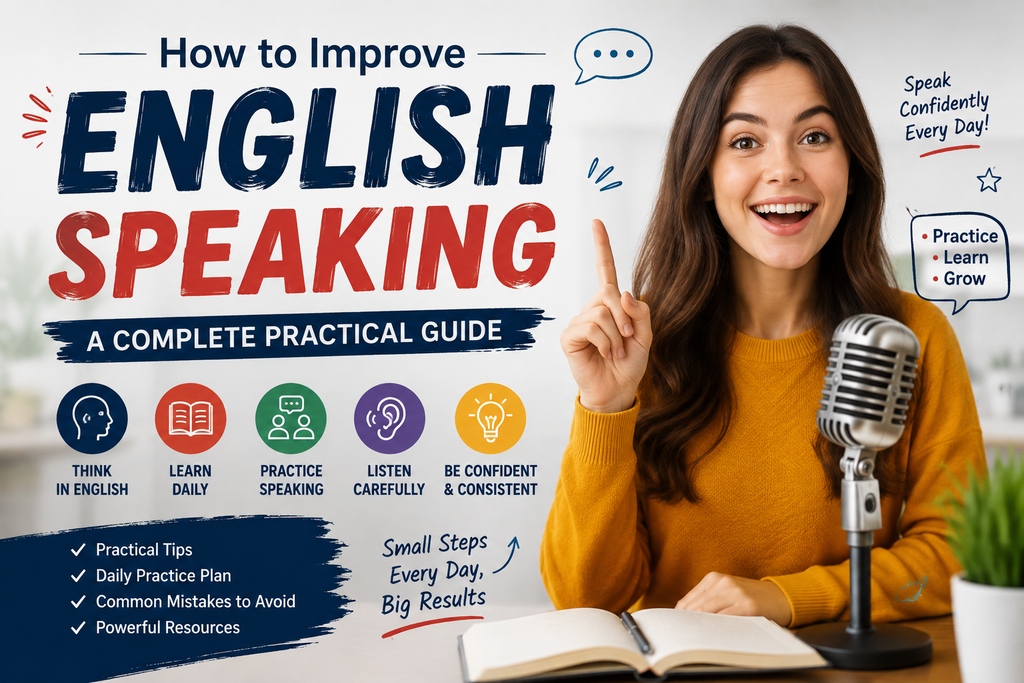
English is one of the most widely used languages in the world. It is important for education, employment, travel, business, communication, entertainment, and access to information. However, many people who can read and understand English still struggle when they have to speak it.
They may know hundreds or even thousands of English words, understand grammar rules, and watch English movies, but when someone asks them a question in English, they suddenly become nervous or cannot find the right words.
The good news is that English speaking is a skill that can be developed through regular practice. You do not need to speak perfect English from the beginning. You need to practice consistently, learn from your mistakes, and gradually become comfortable expressing your thoughts.
This guide explains practical ways to improve English speaking, increase vocabulary, develop pronunciation, overcome fear, and build a daily speaking routine.
Why Is English Speaking Difficult for Many People?
Before improving your speaking ability, it is useful to understand why speaking English can feel difficult.
One common reason is a lack of practice. Many learners spend a lot of time reading grammar books or memorizing vocabulary but spend very little time actually speaking.
Another problem is the fear of making mistakes. Some learners worry that other people will laugh at their pronunciation or grammar. Because of this fear, they avoid speaking altogether.
Some learners also try to translate every sentence from their native language into English. This makes speaking slow because the brain has to perform several steps before producing a sentence.
For example, instead of thinking directly in English, a learner may think:
Native language → English translation → Grammar check → Speaking
A fluent speaker generally needs a much faster process:
Idea → English sentence → Speech
Developing this ability takes practice, but it is possible.
1. Speak English Every Day
The most important rule for improving English speaking is simple: speak every day.
You do not need to speak English for three or four hours daily. Even 15 to 30 minutes of focused speaking practice can make a significant difference when you do it consistently.
You can talk about simple topics such as:
- What you did today
- Your family
- Your studies
- Your job
- Your hobbies
- Your favorite movie
- Your favorite food
- Your future plans
- A recent news story
- A place you want to visit
For example:
“I woke up at seven this morning. I had breakfast with my family and then started working. In the afternoon, I went outside for a walk. In the evening, I watched a movie.”
These sentences may seem simple, but speaking simple English comfortably is an important foundation for becoming fluent.
2. Practice Speaking in Front of a Mirror
Mirror practice is one of the easiest ways to develop confidence.
Stand in front of a mirror and speak English for five to ten minutes. Look at yourself while speaking and try to maintain natural facial expressions.
You can pretend that you are talking to another person.
For example, introduce yourself:
“Hello, my name is Alex. I am from Bangladesh. I am interested in technology, movies, and traveling. I am currently working on improving my English speaking skills.”
Then ask yourself questions:
“What did I do yesterday?”
“What are my goals?”
“What is my favorite movie?”
“What do I want to achieve this year?”
Answer each question aloud.
This activity helps you become more comfortable hearing your own English voice.
3. Stop Being Afraid of Mistakes
One of the biggest barriers to English speaking is the fear of making mistakes.
Remember that mistakes are a normal part of language learning.
Even native speakers sometimes make grammatical mistakes, pronounce words differently, or change their sentences while speaking.
Your goal should not be perfect English. Your first goal should be clear communication.
Instead of thinking:
“Is my grammar perfect?”
Try thinking:
“Can the other person understand what I am saying?”
If the answer is yes, you are communicating successfully.
Over time, you can improve grammar, vocabulary, pronunciation, and sentence structure.
4. Learn English Phrases Instead of Individual Words
Memorizing individual vocabulary words is useful, but learning complete phrases can be even more effective for speaking.
For example, instead of learning only the word “agree,” learn phrases such as:
“I completely agree.”
“I agree with you.”
“I don’t agree with that.”
“That sounds like a good idea.”
Similarly, instead of learning only “opinion,” learn:
“In my opinion…”
“What’s your opinion?”
“I would like to share my opinion.”
These phrases are easier to use in real conversations because you learn how words naturally work together.
5. Think in English
Thinking in English can significantly improve speaking speed.
Many learners first create a sentence in their native language and then translate it into English. This can make speaking slow and uncomfortable.
Start with very simple thoughts.
When you wake up, think:
“I need to get out of bed.”
Then:
“I am going to brush my teeth.”
“I need to make breakfast.”
“I have to start work at nine.”
When you go outside:
“The weather is nice today.”
“There are many people on the street.”
“The traffic is heavy.”
You do not need complicated thoughts. Start with simple sentences and gradually increase their complexity.
6. Improve Your English Pronunciation
Good pronunciation makes communication easier.
You do not necessarily need to sound like a native speaker. Instead, focus on clear and understandable pronunciation.
Choose difficult English words and listen carefully to how they are pronounced.
For example, pay attention to differences between words such as:
- Ship / Sheep
- Live / Leave
- Full / Fool
- Bad / Bed
- Cut / Cat
You can use dictionaries with audio pronunciation and repeat the words several times.
Record yourself saying a word and compare your pronunciation with the original.
7. Use the Shadowing Technique
Shadowing is a powerful technique for improving pronunciation, rhythm, listening, and speaking speed.
Choose a short English video or audio clip. Listen to one sentence and immediately repeat it.
Try to copy:
- Pronunciation
- Rhythm
- Intonation
- Speed
- Pauses
- Word stress
For example, if the speaker says:
“I think this is a great opportunity.”
Listen carefully and repeat the sentence several times.
Do not simply focus on individual words. Try to reproduce the entire sound pattern.
Start with short clips of 30 seconds to one minute. As your ability improves, use longer conversations.
8. Record Your Voice
Recording your own voice is an excellent way to identify weaknesses.
Choose a topic and speak for two minutes. Record yourself using your phone.
After listening, ask:
- Did I speak clearly?
- Did I pause too much?
- Did I repeat the same words?
- Did I make grammatical mistakes?
- Was my pronunciation understandable?
- Did I use enough vocabulary?
Do not become discouraged when you hear mistakes. The purpose of recording is to discover areas that need improvement.
Repeat the same topic after several days and compare the recordings.
You may be surprised by your progress.
9. Expand Your Everyday Vocabulary
You do not need to memorize thousands of difficult words to speak English well.
Focus first on words that are useful in everyday communication.
Learn vocabulary related to:
- Family
- Work
- Education
- Shopping
- Travel
- Food
- Health
- Technology
- Entertainment
- Sports
- Weather
- Daily routines
When learning a new word, create several sentences with it.
For example, if you learn “improve,” create:
“I want to improve my English.”
“She is improving her pronunciation.”
“We need to improve our communication.”
“This exercise can improve your speaking skills.”
Using vocabulary actively is more useful for speaking than simply recognizing words while reading.
10. Have Conversations With Other People
Speaking alone is helpful, but real conversation is essential.
Try to find people who are also learning English. You can practice together and correct each other’s mistakes.
You can discuss simple topics such as:
“What did you do today?”
“What kind of movies do you like?”
“What is your favorite food?”
“Where would you like to travel?”
“What are your career goals?”
During conversations, avoid switching immediately to your native language whenever you forget a word.
Try to explain the idea using other English words.
For example, if you forget the word “umbrella,” you could say:
“It is something we use when it rains.”
This teaches your brain to communicate even when your vocabulary is incomplete.
11. Watch English Movies and Videos
English movies, television programs, interviews, podcasts, and YouTube videos can expose you to natural English.
However, simply watching is not enough.
Use active listening.
Choose a short scene and listen carefully. Write down useful expressions and repeat them aloud.
For example:
“That makes sense.”
“Are you serious?”
“I don’t think so.”
“Let me think about it.”
“What do you mean?”
“That’s a good point.”
These expressions can make your conversations sound more natural.
If the content is too difficult, use English subtitles instead of relying completely on subtitles in your native language.
12. Read Aloud Every Day
Reading aloud connects reading and speaking.
Choose an English article, story, book, or short passage and read it aloud for 10 to 15 minutes.
Focus on pronunciation and natural pauses.
Do not try to read as quickly as possible. Instead, aim for clear and comfortable speech.
Reading aloud can also introduce you to sentence structures and vocabulary that you can later use in conversations.
13. Practice With Questions and Answers
A simple question-and-answer exercise can dramatically improve speaking confidence.
Create 10 questions every day and answer each one aloud.
For example:
Question: What is your favorite hobby?
Answer: My favorite hobby is watching movies because I enjoy learning about different stories and cultures.
Question: What did you do last weekend?
Answer: Last weekend, I stayed at home, watched a movie, and spent some time with my family.
Question: What are your future goals?
Answer: I want to improve my professional skills and become more confident in English communication.
Try to answer without writing the response first.
14. Learn Grammar Through Speaking
Grammar is important, but you do not need to study every grammar rule before speaking.
Focus on the grammar structures that you use frequently.
Start with:
- Present simple
- Present continuous
- Past simple
- Future forms
- Questions
- Negatives
- Common modal verbs
For example:
“I work every day.”
“I am working now.”
“I worked yesterday.”
“I will work tomorrow.”
“I can speak English.”
“I cannot understand the question.”
Practicing these structures aloud makes grammar more automatic.
15. Create a 30-Minute Daily English Routine
A consistent routine can produce better results than occasional long study sessions.
Here is a simple 30-minute routine:
5 minutes — Vocabulary
Learn five useful words or phrases.
5 minutes — Listening
Listen to a short English conversation.
10 minutes — Speaking
Talk about your day, interests, or another topic.
5 minutes — Shadowing
Repeat sentences from an English audio or video.
5 minutes — Review
Think about your mistakes and identify what you need to improve.
If you have more time, extend each activity.
The key is consistency.
16. Use English in Your Daily Life
Try to make English part of your normal routine.
Change some device settings to English. Write your shopping list in English. Make notes in English. Search for information in English. Describe things around you in English.
For example, while preparing food, you can think:
“I am cutting vegetables.”
“The water is boiling.”
“I need to add some salt.”
These small activities train your brain to use English naturally.
17. Improve Your Listening Skills
Speaking and listening are closely connected.
If you cannot understand what another person is saying, having a conversation becomes difficult.
Listen to different English accents and speaking styles. Start with clear, slower speakers and gradually move toward natural-speed conversations.
Try to understand the overall meaning rather than translating every word.
This is particularly important because real-world English can sound very different from textbook English.
18. Practice Speaking Without Preparation
An excellent fluency exercise is the one-minute speaking challenge.
Choose a random topic and speak continuously for one minute.
For example:
“Describe your hometown.”
“Talk about your favorite food.”
“Explain your daily routine.”
“Describe your favorite movie.”
“Talk about your dream vacation.”
At first, you may stop frequently. That is normal.
With practice, you will learn to keep speaking even when you cannot immediately find the perfect word.
Eventually, increase the challenge to two, three, and five minutes.
19. Avoid Comparing Yourself With Fluent Speakers
Another common mistake is comparing your English with someone who has been speaking English for many years.
Instead, compare your current ability with your ability from one month ago.
Ask:
“Can I speak for longer?”
“Do I understand more conversations?”
“Am I using more vocabulary?”
“Am I less afraid of mistakes?”
“Is my pronunciation clearer?”
Progress can be slow at first, but consistent practice produces noticeable improvements over time.
20. Be Patient and Consistent
English fluency does not happen overnight.
Some days you may feel that your English is improving quickly. On other days, you may feel stuck.
That is completely normal.
Language learning is a long-term process. Your brain needs repeated exposure and practice before new vocabulary, grammar patterns, and pronunciation become automatic.
Instead of studying intensely for one day and then stopping for a week, practice a little every day.
Consistency is more powerful than occasional motivation.
A 30-Day English Speaking Challenge
If you want a structured approach, try this simple 30-day challenge.
Days 1–5: Introduce Yourself
Talk about your name, family, education, work, hobbies, and goals.
Days 6–10: Talk About Your Daily Life
Describe your morning, work or study routine, meals, activities, and evening routine.
Days 11–15: Describe People and Places
Talk about your hometown, friends, family members, favorite places, and places you want to visit.
Days 16–20: Share Your Opinions
Discuss movies, technology, education, social media, sports, or other subjects you enjoy.
Days 21–25: Tell Stories
Describe something interesting that happened to you. Try to use past-tense sentences.
Days 26–30: Speak Freely
Choose a topic and speak for five minutes without preparing a written script.
Record yourself and compare your Day 30 recording with your Day 1 recording.
You will likely notice improvements in confidence, vocabulary, pronunciation, and speaking speed.
Common Mistakes to Avoid
When learning English speaking, avoid these habits:
Memorizing grammar without speaking: Grammar knowledge does not automatically create speaking ability.
Waiting for perfect English: You will improve by speaking, not by waiting.
Using extremely difficult vocabulary: Simple words used correctly are often better than complicated words used incorrectly.
Translating every sentence: Try to develop the habit of thinking directly in English.
Speaking only when you feel confident: Confidence usually comes after practice, not before it.
Giving up after mistakes: Every mistake gives you information about what to improve.
Improving English speaking is not about becoming perfect. It is about becoming comfortable, clear, and confident when communicating in English.
The most effective approach combines regular speaking, active listening, vocabulary building, pronunciation practice, shadowing, reading aloud, recording your voice, and real conversations.
Start with simple English. Speak every day. Make mistakes without embarrassment. Learn useful phrases. Think in English whenever possible. Gradually challenge yourself with longer conversations and more complex topics.
If you practice for even 20 to 30 minutes every day, you can build a strong speaking habit. The important thing is not how much English you know today but how consistently you use it.
Remember this simple formula:
Listen → Repeat → Speak → Record → Review → Improve
Do not wait until your English is perfect before you start speaking.
Start speaking today, make mistakes today, learn today, and become better tomorrow.
Frequently Asked Questions (FAQs)
1. How can I improve my English speaking quickly?
Practice speaking every day, even for 15–30 minutes. Combine speaking with listening, shadowing, vocabulary practice, and real conversations. Consistency is more important than studying for long hours occasionally.
2. Can I improve English speaking without a speaking partner?
Yes. You can practice by talking to yourself, using a mirror, recording your voice, reading aloud, describing your surroundings, and answering questions in English. However, speaking with other people is useful for developing conversational skills.
3. How many English words do I need to speak fluently?
There is no exact number. You can communicate effectively with a relatively practical vocabulary if you know how to use common words and phrases naturally. Focus on useful everyday vocabulary rather than memorizing difficult words.
4. How can I stop being afraid of speaking English?
Accept that mistakes are part of learning. Start by speaking privately, then with supportive friends or learners. The more frequently you speak, the more comfortable you will become.
5. How long does it take to improve English speaking?
The time varies from person to person. With regular daily practice, many learners notice improvements within a few weeks or months. Becoming highly fluent usually requires longer-term practice and continued exposure to English.