How to Prepare for Job Interviews: The Complete Guide to Interview Success
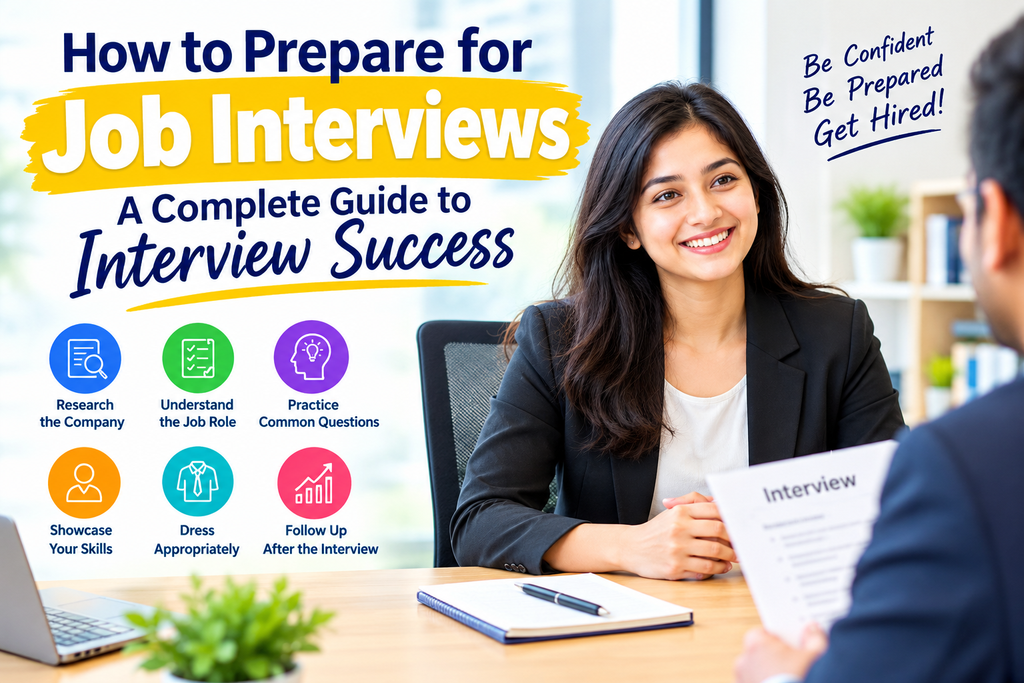
A job interview is one of the most important steps in the hiring process. Your resume may help you get an interview, but your performance during the interview can determine whether you receive a job offer. For many candidates, interviews can feel stressful because they involve answering questions, explaining experience, discussing skills, and demonstrating confidence in a limited amount of time.
The good news is that successful interviews are rarely based on luck. Good preparation can significantly improve your confidence, communication, and ability to present yourself as the right candidate for the position.
Whether you are attending your first job interview, changing careers, applying for a remote position, or preparing for a senior-level role, the basic principles remain similar. You need to understand the company, study the job description, prepare relevant examples, practice common questions, and make sure you can clearly explain the value you can bring to the organization.
This comprehensive guide explains how to prepare for job interviews step by step and how to make a strong impression before, during, and after the interview.
Why Job Interview Preparation Matters
Interview preparation is more than memorizing answers. It helps you understand your own skills and communicate them effectively.
A prepared candidate is usually better able to:
- Answer questions clearly and confidently
- Explain relevant professional experience
- Connect personal skills with the job requirements
- Discuss achievements using real examples
- Handle difficult or unexpected questions
- Ask intelligent questions about the position
- Avoid unnecessary mistakes
- Stay calm under pressure
Preparation also helps reduce interview anxiety. When you know what to expect, you are less likely to become overwhelmed by common interview questions.
However, preparation should not mean memorizing every sentence. Interviewers generally want a natural conversation rather than a rehearsed speech. Your goal should be to understand the key points you want to communicate and practice explaining them naturally.
1. Understand the Job Description
Before preparing answers, carefully read the job description.
Many candidates make the mistake of applying for a position and then preparing only by researching the company. The job description is equally important because it tells you what the employer expects from the successful candidate.
Look for:
- Required technical skills
- Soft skills
- Educational qualifications
- Years of experience
- Responsibilities
- Preferred qualifications
- Software or tools mentioned
- Communication requirements
- Leadership expectations
Make a list of the requirements and compare them with your own experience.
For example, if the employer is looking for someone with communication, teamwork, customer service, and problem-solving skills, think about specific situations where you demonstrated those qualities.
You should be able to answer a simple question:
“Why are your skills relevant to this job?”
Your response should connect your background directly to the employer’s needs.
2. Research the Company
Researching the company is one of the most important interview preparation steps.
Visit the company’s official website and learn about its products, services, customers, mission, culture, and recent developments. If appropriate, also look at its professional social media presence and recent announcements.
Try to understand:
- What does the company do?
- Who are its customers?
- What products or services does it provide?
- What industry does it operate in?
- What are its major goals?
- What makes it different from competitors?
- What values does it emphasize?
You do not need to memorize every detail.
Instead, focus on information that helps you understand why you would want to work there and how your skills could contribute.
Company research also helps you answer questions such as:
“Why do you want to work here?”
A strong answer should be more specific than simply saying, “Because this is a good company.”
3. Know Your Resume
Interviewers often ask questions based directly on information in your resume.
Before the interview, review every section of your resume.
Be prepared to discuss:
- Previous jobs
- Internships
- Education
- Certifications
- Projects
- Technical skills
- Achievements
- Career changes
- Employment gaps
- Responsibilities from previous positions
Never include information on your resume that you cannot explain.
If you mention a particular software program, project, achievement, or responsibility, be prepared for the interviewer to ask follow-up questions.
For example, if your resume says you “improved website traffic,” you should be able to explain what you did, which strategies you used, and what results you achieved.
4. Prepare for Common Interview Questions
Although every interview is different, many questions appear repeatedly.
Some common questions include:
- Tell me about yourself.
- Why do you want this job?
- Why do you want to work for our company?
- What are your strengths?
- What is your biggest weakness?
- Why should we hire you?
- Tell me about a difficult situation you handled.
- Describe a time when you worked as part of a team.
- Where do you see yourself in five years?
- Why did you leave your previous job?
- What salary are you expecting?
- Do you have any questions for us?
Preparing for these questions can help you avoid becoming stuck during the interview.
However, avoid memorizing word-for-word answers. Instead, prepare the main ideas and examples you want to discuss.
5. Practice the “Tell Me About Yourself” Question
“Tell me about yourself” is often one of the first questions in an interview.
Some candidates respond by discussing their entire life history. That is usually unnecessary.
A better approach is to provide a short professional summary.
You can structure your response around:
Present → Past → Future
Start with what you currently do or your professional identity. Then briefly mention relevant previous experience. Finally, explain why you are interested in the position.
For example:
“I am a digital content creator with experience in online publishing, SEO, and content development. Over the past few years, I have worked on creating and optimizing digital content while developing skills in audience engagement and online platforms. I am now looking for an opportunity where I can use these skills in a professional team and continue developing my career.”
The exact answer should reflect your own background.
6. Use the STAR Method
The STAR method is particularly useful for behavioral interview questions.
STAR stands for:
- Situation – Explain the situation.
- Task – Describe your responsibility.
- Action – Explain what you did.
- Result – Describe the outcome.
Suppose the interviewer asks:
“Tell me about a time when you solved a difficult problem.”
Instead of giving a vague answer, use a real example.
Explain what happened, what you were responsible for, what action you personally took, and what happened afterward.
The STAR method keeps your answer organized and prevents you from giving long, confusing explanations.
It is especially useful for questions about:
- Leadership
- Teamwork
- Conflict
- Problem-solving
- Deadlines
- Customer service
- Mistakes
- Project management
- Adaptability
7. Prepare Specific Examples
Employers often want evidence rather than general statements.
Anyone can say:
“I am a good team player.”
A stronger candidate can explain a real situation where they worked with others to achieve a goal.
Prepare several examples from your experience.
Think about situations where you:
- Solved a difficult problem
- Made a mistake and learned from it
- Helped a colleague
- Completed an important project
- Worked under pressure
- Managed competing priorities
- Dealt with a difficult customer
- Learned a new skill quickly
- Improved a process
- Achieved a measurable result
If you are a recent graduate with limited professional experience, examples can come from internships, university projects, volunteer work, freelancing, student organizations, or personal projects.
8. Understand Your Strengths and Weaknesses
Interviewers may ask about your strengths and weaknesses to understand your self-awareness.
When discussing strengths, choose qualities relevant to the job.
For example:
- Communication
- Organization
- Creativity
- Analytical thinking
- Reliability
- Problem-solving
- Adaptability
- Leadership
When discussing weaknesses, avoid giving an answer that directly contradicts an essential requirement of the position.
Instead, identify a genuine area for improvement and explain what you are doing to improve it.
For example:
“I used to spend too much time trying to perfect small details. I have been improving this by setting clearer priorities and deadlines so I can focus more effectively on high-impact tasks.”
This shows awareness and a willingness to improve.
9. Prepare Questions for the Interviewer
An interview is not only an opportunity for the company to evaluate you. It is also your opportunity to evaluate the company.
Near the end of the interview, you may be asked:
“Do you have any questions for us?”
Always try to have a few thoughtful questions ready.
Examples include:
- What would success look like in this role during the first six months?
- What are the biggest priorities for this position?
- How does the team typically collaborate?
- What opportunities are available for professional development?
- What are the next steps in the hiring process?
Avoid asking questions whose answers are already clearly available in the job description.
Thoughtful questions can demonstrate genuine interest and preparation.
10. Choose Appropriate Interview Clothing
Your appearance contributes to the first impression.
The appropriate clothing depends on the company and industry.
For a traditional corporate position, professional business attire may be appropriate. For a creative or technology company, the dress code may be more relaxed.
If you are uncertain, it is generally safer to appear slightly more professional than too casual.
Make sure your clothes are:
- Clean
- Neat
- Comfortable
- Appropriate for the workplace
- Free from distracting damage or stains
Your goal is not to impress the interviewer with expensive clothing. The goal is to look professional and prepared.
11. Plan Your Journey
For an in-person interview, do not wait until the last minute to figure out transportation.
Check:
- Interview location
- Travel time
- Transportation options
- Parking availability
- Building entrance
- Reception procedures
Try to arrive around 10–15 minutes early.
Arriving extremely early can also create unnecessary inconvenience, so there is no need to arrive an hour before the scheduled time.
For online interviews, test your technology beforehand.
Check:
- Internet connection
- Camera
- Microphone
- Headphones
- Video platform
- Lighting
- Background
- Computer battery or power connection
Keep the interview link and necessary contact information easily accessible.
12. Practice Your Body Language
Communication is not only about words.
Your body language can influence how confident and engaged you appear.
During an interview:
- Sit upright
- Maintain natural eye contact
- Avoid constantly looking at your phone
- Listen carefully
- Avoid excessive movement
- Smile naturally when appropriate
- Keep your facial expressions professional
- Show interest when the interviewer speaks
For online interviews, look toward the camera periodically rather than constantly watching your own image.
Good body language should feel natural. You do not need to force yourself into an unnatural posture.
13. Listen Before Answering
One common interview mistake is answering too quickly.
Listen carefully to the entire question.
If you do not understand what the interviewer is asking, it is acceptable to say:
“Could you please clarify what you mean?”
Taking a brief moment to organize your thoughts is also perfectly normal.
A thoughtful answer is generally better than a rushed answer.
14. Keep Answers Clear and Focused
Long answers can sometimes weaken an otherwise good interview.
Try to answer the question directly before providing additional details.
A useful structure is:
Answer → Example → Result
Start with your main point, support it with a relevant example, and finish with the outcome.
If the interviewer wants more information, they can ask a follow-up question.
Avoid going far away from the original question.
15. Be Honest About Your Skills
Never exaggerate your qualifications.
If you do not know something, you can explain that you have not worked with it yet but are willing to learn.
For example:
“I have not used that specific platform professionally, but I have experience with similar tools and I am confident I can learn it quickly.”
Honesty is important because employers may test the skills you claim to have.
A candidate who admits a knowledge gap while demonstrating a willingness to learn can make a better impression than someone who pretends to know everything.
16. Prepare for Difficult Questions
Some interview questions can be uncomfortable.
You may be asked about:
- Employment gaps
- Career changes
- Lack of experience
- Previous mistakes
- Leaving a previous employer
- Salary expectations
- Career setbacks
The best approach is to remain professional and avoid blaming other people.
For example, if you left a previous position because of workplace difficulties, focus on what you learned and what you are looking for next rather than criticizing your former employer.
Interviewers are usually interested in your professionalism and ability to handle challenging situations.
17. Handle Salary Questions Carefully
Salary discussions can be difficult, especially for candidates with limited experience.
Before the interview, research the typical salary range for similar positions in your industry and location.
Consider:
- Your experience
- Education
- Skills
- Industry
- Job responsibilities
- Company size
- Location
- Market conditions
If asked about salary expectations, you can provide a reasonable range rather than an unnecessarily rigid number.
You can also indicate that you are open to discussing the overall compensation package.
Remember that compensation may include more than basic salary, such as bonuses, benefits, remote-work arrangements, training, paid leave, and other benefits.
18. Prepare for Online Interviews
Remote interviews have become common across many industries.
For a virtual interview, choose a quiet location where interruptions are unlikely.
Before the interview:
- Test your microphone.
- Test your camera.
- Check your internet connection.
- Close unnecessary applications.
- Silence phone notifications.
- Keep your resume nearby.
- Position the camera at a comfortable height.
- Make sure your face is adequately lit.
- Check your background.
- Join the meeting a few minutes early.
Technical problems can happen even with good preparation. If something goes wrong, remain calm and communicate professionally.
19. Review the Interviewer and Company Information
If the interview invitation provides the interviewer’s name, take a moment to understand their professional role.
Knowing whether you will be speaking with a recruiter, hiring manager, department leader, or company executive can help you understand what type of discussion to expect.
A recruiter may focus more on qualifications and general fit, while a hiring manager may ask detailed questions about your technical or professional abilities.
20. Avoid Common Interview Mistakes
Even qualified candidates can lose opportunities because of avoidable mistakes.
Common errors include:
- Arriving late
- Failing to research the company
- Not understanding the job description
- Giving extremely long answers
- Speaking negatively about previous employers
- Checking your phone
- Appearing uninterested
- Lying about skills
- Asking no questions
- Focusing only on salary
- Dressing inappropriately
- Interrupting the interviewer
- Failing to follow up afterward
Avoiding these mistakes can immediately improve your interview performance.
21. Follow Up After the Interview
After the interview, a brief professional follow-up message can be appropriate.
Thank the interviewer for their time and express your continued interest in the position.
You do not need to write a long message.
A short and professional thank-you note can reinforce a positive impression.
If the interviewer provided a timeline for the next step, respect that timeline before asking for an update.
22. Learn From Every Interview
Not every interview will result in a job offer.
That does not necessarily mean the interview was a failure.
Each interview provides experience.
After the interview, ask yourself:
- Which questions were difficult?
- Which answers could have been clearer?
- Did I explain my achievements effectively?
- Did I research the company enough?
- Did I ask useful questions?
- Did I appear confident?
- Were there technical problems?
- What would I do differently next time?
Write down your observations while they are still fresh.
Over time, this process can make you significantly better at interviews.
A Simple Interview Preparation Checklist
Use this checklist before your next interview:
Several Days Before
- Read the job description carefully
- Research the company
- Review your resume
- Identify your relevant skills
- Prepare several STAR examples
- Practice common interview questions
- Research the expected salary range
- Prepare questions for the interviewer
The Day Before
- Confirm the interview time
- Check the location or video link
- Prepare your clothes
- Test your technology
- Organize your resume
- Review important company information
- Get enough rest
On Interview Day
- Eat appropriately
- Arrive early or join online a few minutes ahead
- Keep your phone silent
- Bring necessary documents
- Maintain professional body language
- Listen carefully
- Answer honestly
- Ask thoughtful questions
- Thank the interviewer
Final Thoughts
Preparing for a job interview does not mean trying to become someone you are not. The goal is to understand your strengths, communicate your experience clearly, and demonstrate how you can contribute to the organization.
The strongest candidates usually combine preparation with authenticity. They research the company, understand the position, practice common questions, prepare real examples, and remain calm when unexpected questions appear.
Remember that an interview is a two-way conversation. The employer is evaluating whether you are suitable for the role, while you are also deciding whether the company, position, culture, and career opportunities are right for you.
If an interview does not result in an offer, use it as a learning experience rather than assuming you are not qualified. Identify what went well, recognize what could be improved, and apply those lessons to your next opportunity.
With consistent practice, strong preparation, and clear communication, interviews can become less intimidating and much more manageable.
Your resume may open the door, but a well-prepared interview can help you walk through it.
Frequently Asked Questions
1. How early should I arrive for a job interview?
For an in-person interview, arriving about 10–15 minutes early is generally a good approach. For an online interview, joining a few minutes before the scheduled time allows you to check your microphone and camera.
2. What should I say when asked, “Tell me about yourself”?
Give a concise professional summary covering your current situation, relevant experience, key skills, and why you are interested in the position. Keep the answer focused on your professional background.
3. How can I reduce interview anxiety?
Preparation and practice are among the best ways to reduce interview anxiety. Research the company, practice common questions, prepare examples, and arrive early so you do not feel rushed.
4. Should I ask questions at the end of an interview?
Yes. Asking thoughtful questions shows that you are interested in the role and have prepared for the conversation. Ask about responsibilities, team culture, expectations, professional development, or the next steps.
5. What should I do if I do not know the answer to an interview question?
Be honest. Instead of pretending to know something, explain what you do know and, when appropriate, mention how you would learn or solve the problem. Demonstrating honesty and a willingness to learn can make a positive impression.