
Skip to content
-
Subscribe to our newsletter & never miss our best posts. Subscribe Now!
News reflects News Reflects

Breaking News

News reflects News Reflects

Breaking News

  • World News
  • Bangladesh
  • USA
  • Politics
  • Sports
  • Technology
  • Health
  • Entertainment
  • Travel
  • About
    • Contact
    • Home
    • Disclaimer
    • Terms and Conditions
    • Privacy Policy
  • World News
  • Bangladesh
  • USA
  • Politics
  • Sports
  • Technology
  • Health
  • Entertainment
  • Travel
  • About
    • Contact
    • Home
    • Disclaimer
    • Terms and Conditions
    • Privacy Policy
Close

Search

  • https://www.facebook.com/
  • https://twitter.com/
  • https://t.me/
  • https://www.instagram.com/
  • https://youtube.com/
Add Button Text
  • News Reflects
  • About
  • World News
  • USA
  • Bangladesh
  • Politics
  • Entertainment
  • Technology
  • Health
  • Travel
  • Sports
  • Home
  • Disclaimer
  • Terms and Conditions
  • Privacy Policy
Subscribe
NASA Hubble Reveals a Mysterious New Decagon Around Saturn’s South Pole A remarkable new feature has appeared in the atmosphere of Saturn, giving planetary scientists another reason to closely watch the giant ringed world. Observations from NASA’s Hubble Space Telescope have revealed a huge, evolving 10-sided atmospheric wave encircling Saturn’s south pole—a structure scientists are calling a decagon. The discovery is particularly fascinating because Saturn is already famous for a geometric atmospheric phenomenon at its north pole: a giant six-sided jet-stream pattern known as the Saturnian hexagon. The newly observed southern feature is different. Instead of six sides, it appears to have ten, and NASA researchers say it is the first large, regular-sided atmospheric pattern of this kind observed in Saturn’s southern hemisphere. (NASA Science) The discovery comes from observations made by Hubble’s Wide Field Camera 3 (WFC3) on August 29, 2025. NASA released the findings and the associated imagery on September 2, 2026, highlighting how long-term monitoring can reveal atmospheric changes that might otherwise go unnoticed. (NASA Science) A Strange Shape Appears at Saturn’s South Pole When most people picture Saturn, they immediately think of its spectacular rings. But beneath those rings is an enormous, dynamic atmosphere filled with powerful winds, jet streams, storms, clouds, and constantly changing patterns. The newly observed decagon is one of those atmospheric structures. In Hubble’s south-polar view, Saturn appears surrounded by layers of atmospheric bands. Near the pole, however, a darker central region is outlined by a striking shape with approximately ten sides. This pattern is not a solid object and should not be imagined as a physical polygon floating above the planet. Instead, it is an atmospheric wave embedded within one of Saturn’s powerful jet streams. (NASA Science) That distinction is important. Saturn is a gas giant, meaning there is no solid surface comparable to Earth's ground where such a shape could physically sit. The decagon is a pattern created by movements and interactions within the planet's atmosphere. Its existence provides scientists with another natural laboratory for understanding how enormous planetary atmospheres behave. Why Scientists Are Calling It a “Decagon” The term decagon simply describes a shape with ten sides. In this case, scientists are using the word to describe the large-scale atmospheric wave surrounding Saturn's southern polar region. The pattern is visually striking because its boundaries form a much more regular shape than the irregular storms and cloud formations usually associated with planetary atmospheres. NASA describes it as a giant, evolving 10-sided atmospheric wave. Importantly, observations made over several years indicate that the feature has become increasingly distinct since 2023. This suggests researchers may be watching a new atmospheric phenomenon develop rather than simply observing a temporary cloud pattern. (NASA Science) That makes the discovery especially valuable. Planetary scientists rarely get the opportunity to watch such enormous atmospheric structures emerge and change over time. By comparing observations from different years, researchers can investigate whether the feature grows, weakens, shifts, changes shape, or eventually disappears. Hubble’s Long-Term View Makes the Discovery Possible One of the most important aspects of this discovery is not simply the latest photograph. It is the long-term monitoring strategy behind it. The observations are part of NASA’s Outer Planet Atmospheres Legacy (OPAL) program. OPAL has monitored the atmospheres of Jupiter, Saturn, Uranus, and Neptune for more than a decade. The purpose of this continuing program is to build a long-term record of how the atmospheres of the outer planets change. (NASA Science) This kind of monitoring is extremely useful. A single image can show scientists what a planet looks like at one particular moment. A sequence of observations collected over years can reveal something much more important: how the planet behaves. Atmospheres are constantly moving. Winds transport heat and particles, storms appear and disappear, and jet streams can interact with surrounding regions. Some atmospheric structures may last for days or months, while others can survive for years. By repeatedly photographing Saturn, Hubble gives researchers an opportunity to distinguish between short-lived weather events and longer-lasting atmospheric phenomena. The emerging decagon appears to belong to the latter category, although scientists still need more observations to fully understand its origin and evolution. The Decagon Is Located Near 63 Degrees South Latitude The single-filter Hubble image provides an especially clear view of the feature. According to NASA, the decagon is centered around 63 degrees south latitude. (NASA Science) This location places it deep within Saturn's southern polar atmospheric region. The pattern is also embedded in a powerful jet stream. Jet streams are narrow regions of relatively fast-moving atmospheric flow. On Earth, jet streams influence weather patterns and help transport air around the planet. On a gas giant like Saturn, however, jet streams can operate on a vastly larger scale. Saturn's atmosphere contains numerous bands and powerful east-west winds. Near the poles, these atmospheric motions can produce unusual structures. The decagon appears to be associated with one of these powerful flows, making it a potentially important clue about the dynamics of Saturn's atmosphere. It Is More Than a Cloud-Level Pattern Perhaps one of the most scientifically interesting aspects of the discovery is that the decagon appears to extend through multiple layers of Saturn's atmosphere. This suggests the feature is not simply a pattern appearing in one thin layer of clouds. Instead, it appears to have a vertical structure extending through different atmospheric altitudes. (NASA Science) This gives scientists a much richer opportunity to study it. Saturn's atmosphere is not uniform from top to bottom. Different wavelengths of light can reveal different altitudes and atmospheric conditions. When Hubble observes Saturn through different filters, researchers can therefore obtain information about different layers. The decagon's apparent position changes slightly depending on the wavelength being observed. NASA explains that these differences occur because the various wavelengths probe different altitudes in the atmosphere. (NASA Science) In other words, the apparent movement of the pattern between images does not necessarily mean the entire structure is physically moving in a simple way. Scientists are also seeing different portions of a vertically extended atmospheric system. How the Color Image Was Created The colorful NASA image of Saturn's south-polar decagon is visually impressive, but it is important to understand how such astronomical images are produced. The Hubble observations were collected using the WFC3/UVIS instrument. The original observations were made through different filters, including F395N, F502N, and F631N. NASA assigned blue, green, and red colors to these different filter observations to construct the color representation. (NASA Science) This means the colors in the image are not necessarily what a human observer would see with the naked eye. Instead, scientists combine observations at different wavelengths and assign colors to make atmospheric structures easier to distinguish. This technique is widely used in astronomy because much of the information contained in telescope observations cannot be directly perceived by human vision. By converting data into a color image, scientists and the public can more easily recognize differences in atmospheric regions, layers, and structures. A Comparison With Saturn’s Famous Northern Hexagon The discovery naturally invites comparison with Saturn's famous northern hexagon. Saturn's north pole has an enormous six-sided atmospheric pattern that has fascinated scientists for decades. NASA notes that the northern hexagon was first spotted in the 1980s. (NASA Science) The newly observed southern decagon is therefore particularly intriguing. Both features involve large-scale geometric patterns associated with Saturn's atmospheric circulation. But scientists should not automatically assume that the two structures have the same origin. The northern hexagon has been studied extensively, while the southern decagon is a much newer discovery. Researchers are still working to determine exactly how the southern structure forms and why it has ten sides. The contrast between the two poles could eventually help scientists understand why Saturn's atmosphere behaves differently in its northern and southern hemispheres. Could Saturn Really Have Two Geometric Polar Patterns? At first glance, it may seem almost unbelievable that a planet could naturally produce geometric shapes in its atmosphere. But fluid dynamics can generate surprisingly organized structures. Atmospheric gases move according to forces involving rotation, pressure, temperature, momentum, and interactions between different flows. Under particular conditions, these processes can produce waves and persistent patterns. Saturn rotates rapidly, and its atmosphere contains strong jet streams. These conditions provide an environment where complex wave patterns can develop. The decagon therefore does not require anything artificial or mysterious. It is a natural atmospheric phenomenon. What remains mysterious is why this particular ten-sided structure has formed, why it has become increasingly distinct since 2023, and how long it will last. Those are precisely the questions scientists hope continued observations will help answer. Why the Discovery Matters A strange atmospheric shape may sound like a curiosity, but discoveries such as this can have broader scientific importance. Studying Saturn's atmosphere helps researchers understand fluid dynamics under conditions very different from those on Earth. Scientists can use giant planets as natural laboratories. Saturn's enormous size, rapid rotation, powerful jet streams, and deep atmosphere allow researchers to examine atmospheric processes on scales impossible to reproduce easily in a laboratory. Understanding these processes may also improve scientists' knowledge of other planets and atmospheric worlds. The principles of atmospheric circulation are not unique to Saturn. Similar physical processes operate throughout the solar system and, on a broader level, in atmospheres beyond our solar system. The more planetary scientists learn about atmospheric waves, jet streams, and large-scale circulation on planets like Saturn, the better they can interpret atmospheric observations elsewhere. The Importance of Observing Saturn Over Time One of the strongest lessons from the decagon discovery is the importance of patience in astronomy. Space science is not always about finding something spectacular in a single observation. Sometimes the most important discoveries come from comparing images collected years apart. The Hubble OPAL program provides exactly this kind of scientific record. Researchers can look back at previous Saturn observations and compare them with newer images to identify subtle changes. NASA reports that the southern decagon has become increasingly distinct since 2023. (NASA Science) That timeline raises an exciting possibility: scientists may be watching a major atmospheric structure emerge in real time. Future observations could show whether the decagon continues becoming more pronounced, changes its geometry, moves to a different latitude, weakens, or disappears. Each new observation could therefore add another piece to the puzzle. What Does the “X” at the Center Mean? Viewers examining NASA's south-polar image may notice an X surrounded by a dashed circle near the center of Saturn's pole. This does not represent a storm, crater, hole, or mysterious object. NASA explains that the X and dashed circle indicate an area where Hubble did not capture data. (NASA Science) This is an important reminder that astronomical images are scientific data products, not ordinary photographs. A telescope may not collect usable information from every part of an object during an observation. Scientists clearly mark areas where data are missing so viewers do not mistake them for real atmospheric features. Hubble Continues to Reveal Saturn’s Changing Face The Hubble Space Telescope has spent decades observing the universe, but its work within our own solar system remains remarkably valuable. Saturn is too far away for scientists to monitor every detail continuously from spacecraft orbiting the planet. Hubble provides a powerful way to observe Saturn from Earth's vicinity while maintaining a long-term observational record. The new decagon demonstrates why that capability matters. A planet that looks relatively calm from a distance can contain enormous atmospheric structures undergoing dramatic changes. Hubble allows scientists to zoom in on these details and compare them across time. The 2025 observations, released publicly in 2026, provide another fascinating chapter in the continuing study of Saturn. What Scientists May Learn Next The discovery leaves several important questions unanswered. What physical process created the decagon? Why does it have ten sides? Why has the pattern become increasingly distinct since 2023? How deeply does the structure extend into Saturn's atmosphere? How fast does the pattern evolve? And perhaps most intriguingly, how long will it survive? Scientists will need additional observations to answer these questions. Because different wavelengths reveal different atmospheric altitudes, future multiwavelength observations could help researchers map the decagon's vertical structure in greater detail. Long-term monitoring could also reveal whether its geometry remains stable or changes over time. If the feature continues evolving, it could become an important case study in planetary atmospheric dynamics. A New Geometric Wonder on the Ringed Planet Saturn has always been one of the most visually extraordinary planets in our solar system. Its brilliant rings, enormous size, storms, winds, and famous northern hexagon have made it a favorite target for astronomers and space enthusiasts. Now, its southern hemisphere has offered scientists another remarkable mystery. The newly identified decagon is not a solid structure and not a gigantic object sitting above Saturn's clouds. It is an enormous atmospheric wave shaped by the complex movements of Saturn's atmosphere. Its discovery is significant because it appears to be a new and evolving phenomenon. NASA's Hubble observations show that the pattern has become increasingly distinct in recent years, while observations at different wavelengths reveal that it extends through multiple atmospheric layers. (NASA Science) The finding also demonstrates the importance of long-term space observation. A single snapshot can capture a beautiful image, but years of observations can reveal a story. And Saturn's story is still being written. As Hubble and other observatories continue watching the ringed planet, scientists may discover whether the mysterious southern decagon becomes stronger, changes its shape, fades away, or reveals a deeper connection to Saturn's atmospheric circulation. For now, the discovery gives humanity another extraordinary reminder that even planets we have studied for centuries can still surprise us. Saturn may be famous for its rings, but its atmosphere is proving that there is much more to this distant world than meets the eye. 5 Short FAQs About Saturn’s New Decagon 1. What is the decagon on Saturn? The decagon is a giant, 10-sided atmospheric wave surrounding Saturn's south-polar region. It is embedded within a powerful jet stream rather than being a solid object. (NASA Science) 2. Where is Saturn’s decagon located? The feature is centered around approximately 63 degrees south latitude, within Saturn's southern polar atmosphere. (NASA Science) 3. Did Hubble photograph a physical 10-sided object? No. The decagon is an atmospheric pattern created by Saturn's atmospheric dynamics. It is a wave within the planet's atmosphere. 4. Is Saturn’s decagon the same as its famous hexagon? No. Saturn's famous hexagon is located around its north pole and has six sides. The newly discovered feature is around the south pole and has ten sides. (NASA Science) 5. When did Hubble observe the decagon? The Hubble observation featured in NASA's release was made on August 29, 2025, using the Wide Field Camera 3. NASA released the image and related findings on September 2, 2026. (NASA Science) Final Thoughts NASA's latest Hubble observations have added another fascinating mystery to Saturn's already extraordinary atmosphere. The appearance of a large, evolving decagonal wave near the south pole shows that planetary atmospheres can create structures that are both beautiful and scientifically complex. As researchers continue monitoring Saturn, this unusual ten-sided pattern could provide valuable information about jet streams, atmospheric waves, vertical circulation, and the forces shaping the weather of a gas giant. The discovery is a powerful example of why space exploration does not always require traveling to another planet. Sometimes, simply watching carefully—and watching for long enough—can reveal something entirely new. Source: NASA Science — Decagon on Saturn’s South Pole (Color) and NASA’s Hubble Tracks New Decagon Encircling Saturn’s South Pole.
Technology

NASA Hubble Reveals a Mysterious New Decagon Around Saturn’s South Pole
September 5, 2026 11 Min Read
0

A remarkable new feature has appeared in the atmosphere of Saturn, giving planetary scientists another reason to closely watch the giant ringed world. Observations from NASA’s Hubble Space Telescope have revealed a huge, evolving 10-sided atmospheric wave encircling Saturn’s south pole—a structure scientists are calling a decagon.

The discovery is particularly fascinating because Saturn is already famous for a geometric atmospheric phenomenon at its north pole: a giant six-sided jet-stream pattern known as the Saturnian hexagon. The newly observed southern feature is different. Instead of six sides, it appears to have ten, and NASA researchers say it is the first large, regular-sided atmospheric pattern of this kind observed in Saturn’s southern hemisphere. (NASA Science)

The discovery comes from observations made by Hubble’s Wide Field Camera 3 (WFC3) on August 29, 2025. NASA released the findings and the associated imagery on September 2, 2026, highlighting how long-term monitoring can reveal atmospheric changes that might otherwise go unnoticed. (NASA Science)

A Strange Shape Appears at Saturn’s South Pole

When most people picture Saturn, they immediately think of its spectacular rings. But beneath those rings is an enormous, dynamic atmosphere filled with powerful winds, jet streams, storms, clouds, and constantly changing patterns.

The newly observed decagon is one of those atmospheric structures.

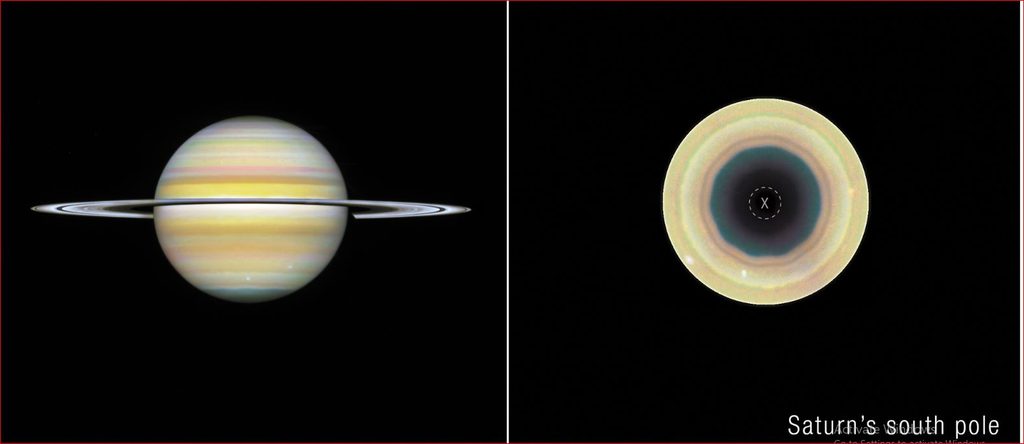
In Hubble’s south-polar view, Saturn appears surrounded by layers of atmospheric bands. Near the pole, however, a darker central region is outlined by a striking shape with approximately ten sides. This pattern is not a solid object and should not be imagined as a physical polygon floating above the planet.

Instead, it is an atmospheric wave embedded within one of Saturn’s powerful jet streams. (NASA Science)

That distinction is important. Saturn is a gas giant, meaning there is no solid surface comparable to Earth’s ground where such a shape could physically sit. The decagon is a pattern created by movements and interactions within the planet’s atmosphere.

Its existence provides scientists with another natural laboratory for understanding how enormous planetary atmospheres behave.

Why Scientists Are Calling It a “Decagon”

The term decagon simply describes a shape with ten sides. In this case, scientists are using the word to describe the large-scale atmospheric wave surrounding Saturn’s southern polar region.

The pattern is visually striking because its boundaries form a much more regular shape than the irregular storms and cloud formations usually associated with planetary atmospheres.

NASA describes it as a giant, evolving 10-sided atmospheric wave. Importantly, observations made over several years indicate that the feature has become increasingly distinct since 2023. This suggests researchers may be watching a new atmospheric phenomenon develop rather than simply observing a temporary cloud pattern. (NASA Science)

That makes the discovery especially valuable.

Planetary scientists rarely get the opportunity to watch such enormous atmospheric structures emerge and change over time. By comparing observations from different years, researchers can investigate whether the feature grows, weakens, shifts, changes shape, or eventually disappears.

Hubble’s Long-Term View Makes the Discovery Possible

One of the most important aspects of this discovery is not simply the latest photograph. It is the long-term monitoring strategy behind it.

The observations are part of NASA’s Outer Planet Atmospheres Legacy (OPAL) program. OPAL has monitored the atmospheres of Jupiter, Saturn, Uranus, and Neptune for more than a decade. The purpose of this continuing program is to build a long-term record of how the atmospheres of the outer planets change. (NASA Science)

This kind of monitoring is extremely useful.

A single image can show scientists what a planet looks like at one particular moment. A sequence of observations collected over years can reveal something much more important: how the planet behaves.

Atmospheres are constantly moving. Winds transport heat and particles, storms appear and disappear, and jet streams can interact with surrounding regions. Some atmospheric structures may last for days or months, while others can survive for years.

By repeatedly photographing Saturn, Hubble gives researchers an opportunity to distinguish between short-lived weather events and longer-lasting atmospheric phenomena.

The emerging decagon appears to belong to the latter category, although scientists still need more observations to fully understand its origin and evolution.

The Decagon Is Located Near 63 Degrees South Latitude

The single-filter Hubble image provides an especially clear view of the feature. According to NASA, the decagon is centered around 63 degrees south latitude. (NASA Science)

This location places it deep within Saturn’s southern polar atmospheric region.

The pattern is also embedded in a powerful jet stream. Jet streams are narrow regions of relatively fast-moving atmospheric flow. On Earth, jet streams influence weather patterns and help transport air around the planet. On a gas giant like Saturn, however, jet streams can operate on a vastly larger scale.

Saturn’s atmosphere contains numerous bands and powerful east-west winds. Near the poles, these atmospheric motions can produce unusual structures.

The decagon appears to be associated with one of these powerful flows, making it a potentially important clue about the dynamics of Saturn’s atmosphere.

It Is More Than a Cloud-Level Pattern

Perhaps one of the most scientifically interesting aspects of the discovery is that the decagon appears to extend through multiple layers of Saturn’s atmosphere.

This suggests the feature is not simply a pattern appearing in one thin layer of clouds. Instead, it appears to have a vertical structure extending through different atmospheric altitudes. (NASA Science)

This gives scientists a much richer opportunity to study it.

Saturn’s atmosphere is not uniform from top to bottom. Different wavelengths of light can reveal different altitudes and atmospheric conditions. When Hubble observes Saturn through different filters, researchers can therefore obtain information about different layers.

The decagon’s apparent position changes slightly depending on the wavelength being observed. NASA explains that these differences occur because the various wavelengths probe different altitudes in the atmosphere. (NASA Science)

In other words, the apparent movement of the pattern between images does not necessarily mean the entire structure is physically moving in a simple way. Scientists are also seeing different portions of a vertically extended atmospheric system.

How the Color Image Was Created

The colorful NASA image of Saturn’s south-polar decagon is visually impressive, but it is important to understand how such astronomical images are produced.

The Hubble observations were collected using the WFC3/UVIS instrument. The original observations were made through different filters, including F395N, F502N, and F631N. NASA assigned blue, green, and red colors to these different filter observations to construct the color representation. (NASA Science)

This means the colors in the image are not necessarily what a human observer would see with the naked eye.

Instead, scientists combine observations at different wavelengths and assign colors to make atmospheric structures easier to distinguish.

This technique is widely used in astronomy because much of the information contained in telescope observations cannot be directly perceived by human vision.

By converting data into a color image, scientists and the public can more easily recognize differences in atmospheric regions, layers, and structures.

A Comparison With Saturn’s Famous Northern Hexagon

The discovery naturally invites comparison with Saturn’s famous northern hexagon.

Saturn’s north pole has an enormous six-sided atmospheric pattern that has fascinated scientists for decades. NASA notes that the northern hexagon was first spotted in the 1980s. (NASA Science)

The newly observed southern decagon is therefore particularly intriguing.

Both features involve large-scale geometric patterns associated with Saturn’s atmospheric circulation. But scientists should not automatically assume that the two structures have the same origin.

The northern hexagon has been studied extensively, while the southern decagon is a much newer discovery. Researchers are still working to determine exactly how the southern structure forms and why it has ten sides.

The contrast between the two poles could eventually help scientists understand why Saturn’s atmosphere behaves differently in its northern and southern hemispheres.

Could Saturn Really Have Two Geometric Polar Patterns?

At first glance, it may seem almost unbelievable that a planet could naturally produce geometric shapes in its atmosphere.

But fluid dynamics can generate surprisingly organized structures.

Atmospheric gases move according to forces involving rotation, pressure, temperature, momentum, and interactions between different flows. Under particular conditions, these processes can produce waves and persistent patterns.

Saturn rotates rapidly, and its atmosphere contains strong jet streams. These conditions provide an environment where complex wave patterns can develop.

The decagon therefore does not require anything artificial or mysterious. It is a natural atmospheric phenomenon.

What remains mysterious is why this particular ten-sided structure has formed, why it has become increasingly distinct since 2023, and how long it will last.

Those are precisely the questions scientists hope continued observations will help answer.

Why the Discovery Matters

A strange atmospheric shape may sound like a curiosity, but discoveries such as this can have broader scientific importance.

Studying Saturn’s atmosphere helps researchers understand fluid dynamics under conditions very different from those on Earth.

Scientists can use giant planets as natural laboratories. Saturn’s enormous size, rapid rotation, powerful jet streams, and deep atmosphere allow researchers to examine atmospheric processes on scales impossible to reproduce easily in a laboratory.

Understanding these processes may also improve scientists’ knowledge of other planets and atmospheric worlds.

The principles of atmospheric circulation are not unique to Saturn. Similar physical processes operate throughout the solar system and, on a broader level, in atmospheres beyond our solar system.

The more planetary scientists learn about atmospheric waves, jet streams, and large-scale circulation on planets like Saturn, the better they can interpret atmospheric observations elsewhere.

The Importance of Observing Saturn Over Time

One of the strongest lessons from the decagon discovery is the importance of patience in astronomy.

Space science is not always about finding something spectacular in a single observation. Sometimes the most important discoveries come from comparing images collected years apart.

The Hubble OPAL program provides exactly this kind of scientific record. Researchers can look back at previous Saturn observations and compare them with newer images to identify subtle changes.

NASA reports that the southern decagon has become increasingly distinct since 2023. (NASA Science)

That timeline raises an exciting possibility: scientists may be watching a major atmospheric structure emerge in real time.

Future observations could show whether the decagon continues becoming more pronounced, changes its geometry, moves to a different latitude, weakens, or disappears.

Each new observation could therefore add another piece to the puzzle.

What Does the “X” at the Center Mean?

Viewers examining NASA’s south-polar image may notice an X surrounded by a dashed circle near the center of Saturn’s pole.

This does not represent a storm, crater, hole, or mysterious object.

NASA explains that the X and dashed circle indicate an area where Hubble did not capture data. (NASA Science)

This is an important reminder that astronomical images are scientific data products, not ordinary photographs.

A telescope may not collect usable information from every part of an object during an observation. Scientists clearly mark areas where data are missing so viewers do not mistake them for real atmospheric features.

Hubble Continues to Reveal Saturn’s Changing Face

The Hubble Space Telescope has spent decades observing the universe, but its work within our own solar system remains remarkably valuable.

Saturn is too far away for scientists to monitor every detail continuously from spacecraft orbiting the planet. Hubble provides a powerful way to observe Saturn from Earth’s vicinity while maintaining a long-term observational record.

The new decagon demonstrates why that capability matters.

A planet that looks relatively calm from a distance can contain enormous atmospheric structures undergoing dramatic changes. Hubble allows scientists to zoom in on these details and compare them across time.

The 2025 observations, released publicly in 2026, provide another fascinating chapter in the continuing study of Saturn.

What Scientists May Learn Next

The discovery leaves several important questions unanswered.

What physical process created the decagon?

Why does it have ten sides?

Why has the pattern become increasingly distinct since 2023?

How deeply does the structure extend into Saturn’s atmosphere?

How fast does the pattern evolve?

And perhaps most intriguingly, how long will it survive?

Scientists will need additional observations to answer these questions.

Because different wavelengths reveal different atmospheric altitudes, future multiwavelength observations could help researchers map the decagon’s vertical structure in greater detail.

Long-term monitoring could also reveal whether its geometry remains stable or changes over time.

If the feature continues evolving, it could become an important case study in planetary atmospheric dynamics.

A New Geometric Wonder on the Ringed Planet

Saturn has always been one of the most visually extraordinary planets in our solar system. Its brilliant rings, enormous size, storms, winds, and famous northern hexagon have made it a favorite target for astronomers and space enthusiasts.

Now, its southern hemisphere has offered scientists another remarkable mystery.

The newly identified decagon is not a solid structure and not a gigantic object sitting above Saturn’s clouds. It is an enormous atmospheric wave shaped by the complex movements of Saturn’s atmosphere.

Its discovery is significant because it appears to be a new and evolving phenomenon. NASA’s Hubble observations show that the pattern has become increasingly distinct in recent years, while observations at different wavelengths reveal that it extends through multiple atmospheric layers. (NASA Science)

The finding also demonstrates the importance of long-term space observation. A single snapshot can capture a beautiful image, but years of observations can reveal a story.

And Saturn’s story is still being written.

As Hubble and other observatories continue watching the ringed planet, scientists may discover whether the mysterious southern decagon becomes stronger, changes its shape, fades away, or reveals a deeper connection to Saturn’s atmospheric circulation.

For now, the discovery gives humanity another extraordinary reminder that even planets we have studied for centuries can still surprise us.

Saturn may be famous for its rings, but its atmosphere is proving that there is much more to this distant world than meets the eye.


5 Short FAQs About Saturn’s New Decagon

1. What is the decagon on Saturn?

The decagon is a giant, 10-sided atmospheric wave surrounding Saturn’s south-polar region. It is embedded within a powerful jet stream rather than being a solid object. (NASA Science)

2. Where is Saturn’s decagon located?

The feature is centered around approximately 63 degrees south latitude, within Saturn’s southern polar atmosphere. (NASA Science)

3. Did Hubble photograph a physical 10-sided object?

No. The decagon is an atmospheric pattern created by Saturn’s atmospheric dynamics. It is a wave within the planet’s atmosphere.

4. Is Saturn’s decagon the same as its famous hexagon?

No. Saturn’s famous hexagon is located around its north pole and has six sides. The newly discovered feature is around the south pole and has ten sides. (NASA Science)

5. When did Hubble observe the decagon?

The Hubble observation featured in NASA’s release was made on August 29, 2025, using the Wide Field Camera 3. NASA released the image and related findings on September 2, 2026. (NASA Science)

Final Thoughts

NASA’s latest Hubble observations have added another fascinating mystery to Saturn’s already extraordinary atmosphere. The appearance of a large, evolving decagonal wave near the south pole shows that planetary atmospheres can create structures that are both beautiful and scientifically complex.

As researchers continue monitoring Saturn, this unusual ten-sided pattern could provide valuable information about jet streams, atmospheric waves, vertical circulation, and the forces shaping the weather of a gas giant.

The discovery is a powerful example of why space exploration does not always require traveling to another planet. Sometimes, simply watching carefully—and watching for long enough—can reveal something entirely new.

Source: NASA Science — Decagon on Saturn’s South Pole (Color) and NASA’s Hubble Tracks New Decagon Encircling Saturn’s South Pole.

Post Views: 91
Author

newsreflects.com

Breaking News !Treading News

Follow Me
Other Articles
How to Strengthen Your Immune System Naturally: 20 Practical Ways to Support Your Body’s Defenses
Previous

How to Strengthen Your Immune System Naturally: 20 Practical Ways to Support Your Body’s Defenses

Apple iPhone 18 Pro and iPhone Ultra: How Apple’s Biggest 2026 iPhone Changes Could Reshape the Smartphone Market
Next

Apple iPhone 18 Pro and iPhone Ultra: How Apple’s Biggest 2026 iPhone Changes Could Reshape the Smartphone Market

No Comment! Be the first one.

Leave a Reply Cancel reply

Your email address will not be published. Required fields are marked *

Recent Posts

  • Real Madrid Deliver a Night of Spectacular Goals as Mbappé Shines in 4-1 Victory Over Sevilla Ahead of El Clásico
  • PS6 RAM and Storage Costs Reportedly Exceed $680: What the Latest Leak Means for Sony’s Next-Generation Console
  • Bayern Munich President Backs Harry Kane for the Ballon d’Or: Why the Club Believes Its Striker Deserves Football’s Top Individual Prize
  • Tricolour March at Connaught Place: Abhijeet Dipke Says He May Be Arrested as Cockroach Janta Party Escalates Its Delhi Protests
  • Six Flags Over Georgia Roller Coaster Accident: One Dead and Several Injured as Authorities Investigate

Recent Comments

  1. Blooming Wonders & Perfect Weather: 5 Must-Visit US Places That Shine Brightest in May - News Reflects on Chaos at the Crescent City Skies: New Orleans Airport Paralyzed by Government Shutdown Fallout – Travelers Face Massive Delays and Cancellations
  2. newsreflects.com on The Feud Ends in a Blockbuster Twist: Novo Nordisk and Hims & Hers Bury the Hatchet to Bring Obesity Drugs to More Patients Together
  3. Isha on The Feud Ends in a Blockbuster Twist: Novo Nordisk and Hims & Hers Bury the Hatchet to Bring Obesity Drugs to More Patients Together

Archives

  • October 2026
  • September 2026
  • August 2026
  • June 2026
  • April 2026
  • March 2026
  • February 2026
  • November 2025

Categories

  • Bangladesh
  • Entertainment
  • Health
  • Politics
  • Sports
  • Technology
  • Travel
  • Uncategorized
  • USA
  • World News
  • Real Madrid Deliver a Night of Spectacular Goals as Mbappé Shines in 4-1 Victory Over Sevilla Ahead of El Clásico
  • PS6 RAM and Storage Costs Reportedly Exceed $680: What the Latest Leak Means for Sony’s Next-Generation Console
  • Bayern Munich President Backs Harry Kane for the Ballon d’Or: Why the Club Believes Its Striker Deserves Football’s Top Individual Prize
  • Tricolour March at Connaught Place: Abhijeet Dipke Says He May Be Arrested as Cockroach Janta Party Escalates Its Delhi Protests
  • Six Flags Over Georgia Roller Coaster Accident: One Dead and Several Injured as Authorities Investigate

  • Facebook
  • Instagram
  • Tumblr
  • Pinterest
  • YouTube

Footer

  • World News
  • Bangladesh
  • USA
  • Politics
  • Sports
  • Technology
  • Health
  • Entertainment
  • Travel
  • About
    • Contact
    • Home
    • Disclaimer
    • Terms and Conditions
    • Privacy Policy

Copyright 2026 — News Reflects. All rights reserved. Blogsy WordPress Theme

Powered by
Necessary cookies enable essential site features like secure log-ins and consent preference adjustments. They do not store personal data.
None
Functional cookies support features like content sharing on social media, collecting feedback, and enabling third-party tools.
None
Analytical cookies track visitor interactions, providing insights on metrics like visitor count, bounce rate, and traffic sources.
None
Advertisement cookies deliver personalized ads based on your previous visits and analyze the effectiveness of ad campaigns.
None
Unclassified cookies are cookies that we are in the process of classifying, together with the providers of individual cookies.
None
Powered by